

Route optimization has always been a central challenge across Courier, Express & Parcel (CEP) networks, retail fulfillment, and transport & logistics operations. Every day, planners must turn volatile constraints such as traffic, time windows, capacity, service levels into executable routes that balance cost and service.
Over the last decades, the industry has shifted from manual planning to powerful optimization engines. Today, AI adds a new layer: faster computation, better pattern detection, and more intuitive decision support. But it also raises a more strategic question:
Are we using AI to get better routes or to make better decisions?
This blog explains the evolution from algorithms to decision intelligence, why AI alone doesn’t solve the complexity challenge, and how conversational interfaces make route planning far more accessible.
Key Takeaways
- Route optimization is evolving from algorithmic routing toward decision intelligence, where planners compare trade‑offs across cost, service, and CO₂ and not just generate routes.
- AI accelerates computation and improves pattern recognition, but it does not replace expert judgment. The real value comes from helping teams interpret results and explore options.
- Conversational AI is transforming route planning by letting planners ask questions in natural language instead of adjusting parameters, making complex analysis more accessible across the organization.
- PTV Mira represents this new approach, offering a conversational interface for investigating routes, testing scenarios, and understanding optimization logic more transparently.
- The future of AI in route planning and optimization will combine fast computation, explainability, human‑in‑the‑loop workflows, and decision intelligence to help logistics teams react faster and plan with more confidence.
The core problem: Routing was never just a math issue
For years, optimization engines solved routing exceptionally well. But logistics operations require something bigger:
- balancing cost vs service
- handling unplanned orders
- managing CO₂ goals
- evaluating same-day options
- understanding customer promises
- coordinating drivers and fleet constraints
In reality, planners rarely need “the mathematically best route.” They need the best overall decision; something algorithms alone cannot provide. This is why the industry is shifting from pure optimization to decision intelligence.
Why current approaches struggle
Current routing tools still leave a gap between high‑quality routes and high‑quality decisions. Three issues show up across almost every logistics operation:
- Optimization engines became powerful but also complex
Solvers can evaluate millions of combinations fast, but they are difficult to tune, sensitive to data quality, and often dependent on superusers. Planners spend more time configuring models than analyzing outcomes.
- AI makes algorithms faster, but not automatically better
AI improves computation and pattern recognition, yet it cannot understand trade‑offs, prioritize service exceptions, or justify decisions. Human judgment is still required to interpret results.
- The last mile is too dynamic for static routing logic
Weather, late parcels, customer changes, driver shortages – CEP, retail, and transport teams deal with issues that algorithms alone can’t anticipate. Speed without context doesn’t create better planning. This is where decision intelligence becomes essential.
A brief history of route optimization
Route planning started with manual maps, local knowledge and basic heuristics (“cluster, then route”). Eventually, solver-based engines emerged: vehicle routing problem (VRP), TSP variations, heuristics, metaheuristics, constraint programming. Tools became industrial-level, but also:
- parameter-heavy
- sensitive to data quality
- difficult for non-experts to configure
- hard to interpret (“Why did the solver choose that?”)
Planners got better routes but not necessarily clearer decisions.
AI accelerates three major building blocks:
- Faster computation: AI‑boosted solvers evaluate more options in less time.
- Better pattern recognition: AI identifies patterns in traffic, sequence choices, parcel density, service failures, and driver behavior.
- Still expert‑dependent: Even with AI, someone must set priorities, understand constraints, and evaluate trade‑offs.
Faster algorithms don’t automatically lead to better decisions, because the real bottleneck in routing is no longer computation but interpretation.

Planners need to understand not just what the system generates, but why a particular route or solution was chosen, and this requires context, judgment, and clarity that raw speed alone cannot provide.
Read further about the strengths and limitations of AI in routing here: Leveraging AI for Route Optimization: Pros, Limits and Risks
The shift from Optimization to Decision Intelligence
Decision intelligence reframes route planning from answering:
“What is the best route?”
to
“What is the best option given my constraints, trade-offs, and goals?”
It includes:
- evaluating cost vs service
- comparing CO₂ trade-offs
- identifying exceptions
- suggesting resolutions
- providing explainability
One of the core components of decision intelligence is prescriptive analytics, which guides planners toward the best choice among multiple valid routing options.
Prescriptive analytics in route optimization
Prescriptive analytics in route optimization goes a step beyond traditional routing by automatically recommending the best operational choice for each situation. Instead of simply presenting multiple route options, prescriptive models guide planners with clear, actionable suggestions such as minimizing CO₂ emissions, prioritizing fastest delivery, avoiding overtime, or flagging clusters that require capacity adjustments. In this way, prescriptive analytics bridges the gap between mathematical optimization and real‑world decision‑making.
AI and Conversational Route Optimization
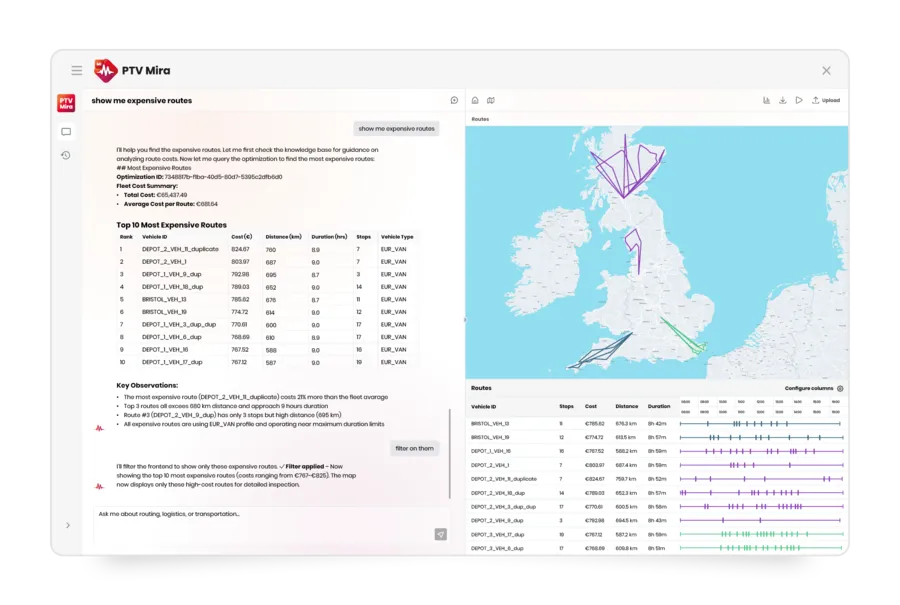
For decades, planners had to learn complex routing software. Conversational AI in route planning flips this around.
Instead of configuring models, planners can ask questions:
- “Why is route 12 so long today?”
- “Which stops increased CO₂ output?”
- “What if we moved these orders to another depot?”
- “Show me inefficient routes.”
- “Which couriers are overloaded?”
The interface becomes a partner, not a barrier.
Now with conversational AI in route optimization:
- planners can explore scenario logic without needing to rely on technical specialists for every question
- supervisors can understand route impacts quickly
- new employees get up to speed faster
- operations leaders can test strategic decisions
Conversational AI in route planning and optimization democratizes planning.
See conversational route optimization live with PTV Mira
If conversational AI can make route planning more accessible, the next step is to see how it behaves in real operations. PTV Mira acts as a conversational interface for route decision-making, helping teams interpret route plans, explore scenarios, and understand optimization logic through transparent explanations.

Real use cases for conversational route planning and optimization
Across CEP, retail, and transport networks, AI in route optimization supports daily decisions in new ways:
1. Filtering inefficient routes
AI identifies patterns like:
- unusually long detours
- underutilized vehicles
- overloaded couriers
- routes with repetitive service failures
- recurring late-day congestion zones
Planners can drill into why, not just what.
2. Scenario testing (“what-if” analysis)
AI helps compare options with clear trade-off explanations. Common examples include:
- “What if we add a micro-fulfillment center?”
- “What if we reduce the fleet by two vans?”
- “What if we change driver shifts?”
- “What if we move evening deliveries to the morning?”
If you want to see how systematic scenario testing works in a real network, this PTV Mira example video uses a Belgian logistics operation to evaluate multiple depot locations, identify long‑distance inefficiencies, and reveal which depot could be removed to reduce fleet size and kilometers driven:
See how PTV Mira tests multiple depot scenarios side‑by‑side here.
3. Investigating unplanned or late orders
AI surfaces root causes:
- late customer confirmation
- unrealistic time windows
- depot imbalance
- misclustered stop
- unexpected traffic spikes
The planner can adjust quickly without rebuilding everything.
The Future of AI in Route Optimization
1. Human-in-the-loop decision-making
AI will increasingly handle the heavy computational lifting, but the final decision will continue to sit with people who understand customer promises, service priorities, and workforce realities. The combination of fast AI suggestions and human judgment creates decisions that are both efficient and operationally grounded.
2. Explainability and trust
For AI to be adopted in logistics, it must show its reasoning. Planners need to understand why a recommendation was made, which assumptions were applied, how trade‑offs compare, and what risks they should be aware of. Transparent systems build trust – without it, even the best optimization will never make it into daily operations.
3. Speed becomes a competitive advantage
The next era of logistics is about enabling faster decisions. AI will help teams respond more quickly to disruptions, simulate scenarios in seconds, shorten weekly planning cycles, and rebalance routes or depots with greater agility. In an industry defined by volatility, the teams that decide faster will outperform the ones that simply compute faster.
FAQ about AI and Route Optimization
How is AI used in route optimization?
AI accelerates computation, identifies patterns, highlights inefficiencies, and supports decision-making with prescriptive prompts and scenarios.
What is decision intelligence in logistics?
A framework that combines optimization, AI, and human judgment to select the best option – not just the best route.
Can AI replace route planners?
No. AI handles complexity and scenarios; planners handle priorities, trade-offs, and real-world judgment. Instead of replacing planners, PTV Logistics builds solutions that automate the heavy routing work while giving teams clearer insights and more control over daily decisions.
What’s the difference between AI and optimization algorithms?
Algorithms compute the best mathematical route. AI interprets patterns, exposes trade-offs, explains results, and supports decisions.
Why does conversational AI matter in logistics planning?
It removes the barrier of technical expertise. Planners can explore models through natural language instead of configuring complex settings. With PTV Mira, this means teams can investigate routes, compare scenarios, and understand optimization logic simply by asking questions.
What is conversational route optimization and how does PTV Mira support it?
Conversational route optimization allows planners to interact with routing logic through natural language instead of navigating complex settings or parameters. Instead of configuring models manually, planners can ask questions such as “Why is this route overloaded?” or “What happens if we move these stops?” and receive clear, explainable insights. PTV Mira applies this concept by offering a conversational interface on top of proven optimization technology, helping planners explore scenarios, understand trade‑offs, and make decisions more confidently.