
For some time in the logistics space, there has been a perceived tension between costs and service levels. However, as we cross into the second half of the decade, this binary choice is becoming increasingly obsolete. With the right approach to strategic optimization, the goal is no longer to choose one over the other, but to find the optimal strategy where both can be prioritized.
Why focus has shifted to both service and cost
Whether in the consumer or B2B market, there is a minimum level of reliability expected of logistics operations. It is no longer enough to simply be fast; you must also be precise. Whether it’s a retail manager waiting for stock replenishment or a homeowner expecting a parcel, today, a missed window often costs more in penalties and churn than the delivery itself was worth.
How can logistics providers meet these greater demands without adding more vehicles to their fleet? Read on, to find out.
Moving from the shortest path to the most reliable path
Standard routing looks for the fewest kilometers. Strategic optimization looks for the highest probability of success. In the retail sector, for example, the cost of a store standing empty for an hour is far higher than the fuel saved by taking a shorter, traffic-prone backroad.
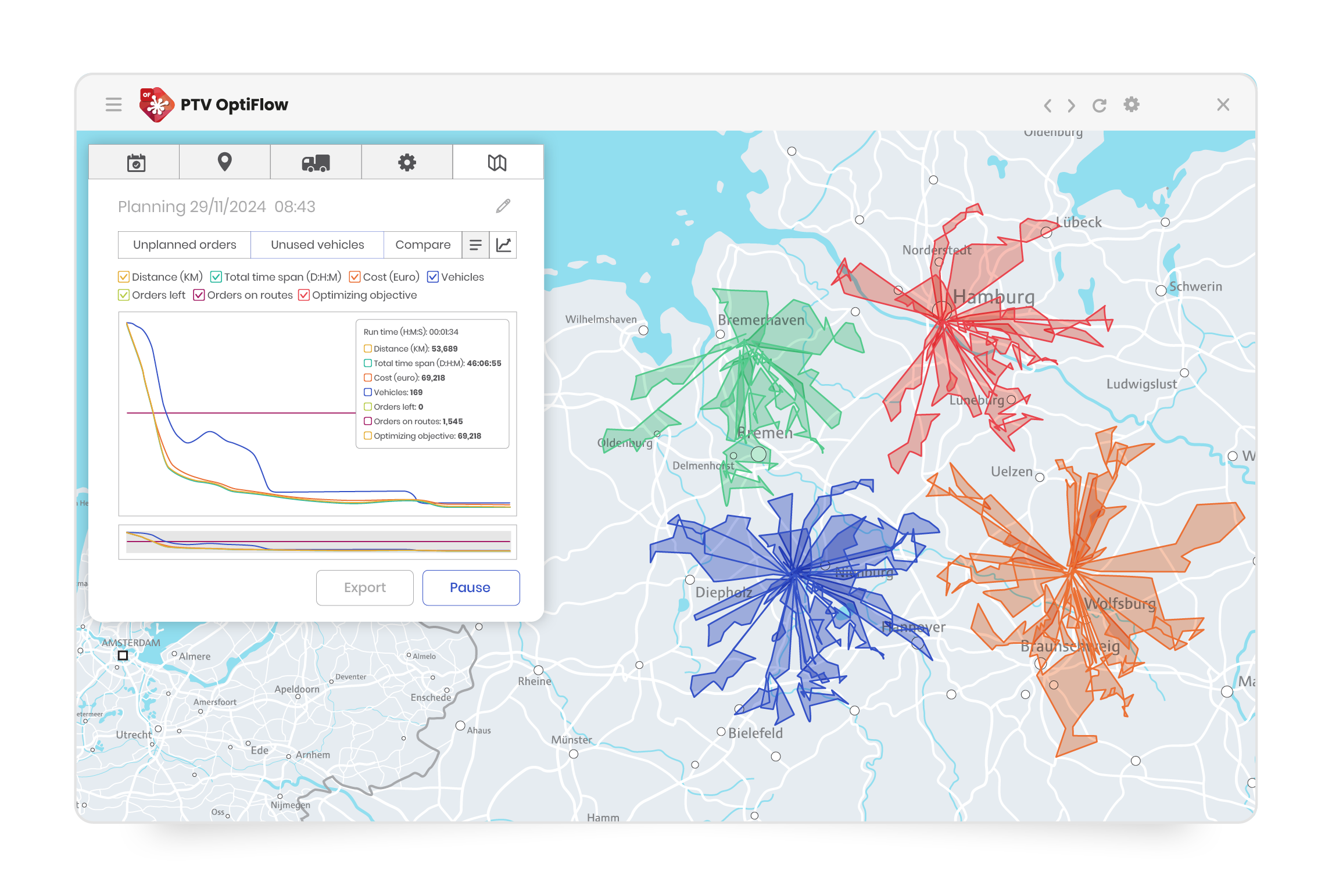
By using PTV OptiFlow, route planners can prioritize on-time arrival probability. The system analyzes historical traffic data to build routes that are statistically likely to succeed, ensuring store shelves stay full without needing extra redundant vehicles on standby. No matter how many stores make up a retail chain, with the right software, every schedule and journey can be stored, allowing managers to collect a wealth of data about all their trips, customers, vehicles, and drivers. This data is indispensable not only for methodically reducing your costs regarding one route, but across your entire fleet.
Related: 5 benefits of route planning for retailers and wholesalers
Eliminate service waste with smart sectorization
Often, high costs aren’t caused by the service level itself, but by the inefficiency of how that service is delivered. In the Courier, Express, and Parcel (CEP) space, high-density urban tours often suffer from territories shifting and overlapping, with drivers from different sectors ending up on the same street.
By implementing smart sectorization, it becomes possible to dynamically redraw boundaries every morning based on the day’s specific parcel density. This ensures that every driver has a tight cluster of stops, maximizing drops-per-hour without increasing the total fleet size.
It can also ensure drivers are not stuck waiting in an idle truck or needlessly driving along the same route as their colleagues. Instead, they are where managers need them to be. Where customers want them to be.
Scale for seasonal peaks without fixed costs
The modern economy is defined by fluctuating demand. Black Friday, holiday surges, and flash sales create massive service pressure that can lead to panic-hiring and expensive short-term vehicle rentals.
Let’s look at the Transport & Logistics sector. Instead of being at the mercy of the market, providers can use optimization software to run “what-if” scenarios during the planning phase. By simulating, say, a 20% increase in volume or a mid-season lull, a 3PL can identify exactly where their current fleet is likely to fail and where they need to pull in temporary partner carriers. This strategic optimization prevents over-investment in fixed assets while ensuring service levels remain flawless during the busiest weeks of the year. This becomes tangible in real operations. For example, ID Logistics uses PTV OptiFlow to centrally plan more than 400 daily routes with just two planners while also reducing planning time by up to two hours per day.
See transparency as a cost-saver
High-level service doesn’t always mean faster. Often, it just means informed – of what’s happening on the road, in your warehouse and with your customers.
Real-time visibility has become a standard requirement in modern logistics, critical for improving both costs and service levels. When a system can provide an accurate ETA, the failed delivery rate drops significantly. For a logistics provider, every successful first-time delivery is a massive win for both bottom line and reputation.
Want to know more about how better communication influences transparency and, ultimately, costs?
Read about it here: Effective tracking and communication strategies for last mile delivery
The rise of AI-driven route optimization
AI has moved from a futuristic concept to a standard operational requirement for many modern logistics providers. Its primary value lies in its ability to process thousands of variables – driver hours, EV charging states, CO2-weighted tolls, and live traffic – in a matter of seconds.
These AI tools are robust, reliable, and self-learning. And crucially, they’re good value, too. Boston Consulting Group has found that logistics firms adopting AI tools typically experience a full ROI within 18 to 24 months. That’s prioritizing cost and service in a way that pays off.
FAQ: Common service and cost questions in logistics
How does PTV OptiFlow help with specific time windows?
Unlike manual planning, PTV OptiFlow treats time windows as a hard constraint. It mathematically sequences thousands of orders to ensure every single one hits its window while still minimizing the total kilometers driven across the entire fleet.
Does improving service always mean hiring more drivers?
No. In fact, most of the logistics providers using PTV OptiFlow find that they can improve service simply by better utilizing their existing drivers. The software identifies hidden capacity – time wasted in traffic or inefficient stop sequences – and turns it into productive delivery time.
With better‑optimized routes and smarter sequencing, your existing drivers can complete more stops on time, boosting both efficiency and reliability.
What is the best way to handle urgent, last-minute orders?
The most effective method is dynamic rerouting, which is built directly into PTV OptiFlow. Instead of only planning the morning tours, the system continuously adapts throughout the day.
Modern software shouldn’t just plan the morning; it should adapt to the afternoon. If a high-priority order arrives, the software re-calculates the existing tours to see which driver can pick it up with the least impact on their current commitments.
Can optimization help with my green service targets?
It certainly can. For many, sustainability is a service level requirement. By reducing mileage and idle time, optimization automatically lowers your carbon footprint, helping you meet the strict ESG demands held by some corporate clients.
Many companies are now embedding route optimization into broader green logistics strategies to improve transparency, measure emissions more accurately, and actively reduce their environmental impact.
Click here to learn more about how smarter planning supports sustainability goals.