
Intelligent network planning is an approach to logistics network design that answers strategic, tactical and operational questions on one optimization model that carries every real constraint of your daily operation. Depot decisions, territory changes and tomorrow’s routes all come from the same engine, and what happens on the road feeds back into each of them. That was the core message of Dr. An De Wispelaere, Chief Innovation Officer (CIO) at PTV Logistics, in her keynote at Leaders in Logistics on October 7, 2026.
Key takeaways
- Network studies built on averages rarely survive contact with the depot, because real time windows, traffic and driver rules are missing from them.
- Replaying last month’s real orders with a new depot in place gives far more confidence than a forecast worked out on averages.
- A planning model earns trust when it holds every operational constraint, runs in the daily planning tool and is run by your own planners.
An opened with a story most people think they know:
At 11:40 p.m. on April 14, 1912, the Titanic struck an iceberg. Passengers felt a faint shudder, barely enough to rattle the glasses in the lounge. Half an hour later they were told to put on life jackets and go to the boats. The lights were still on, the ship was warm, and the band was playing. Twenty meters below the railing hung a small wooden boat above black, freezing water.
The first lifeboat lowered that night had room for 65 people. It left with about 28. Several early boats went down with dozens of empty seats, because passengers were comparing a danger they could see with one they could not see yet. By the time the danger was obvious, most of the boats were gone.
“I think many of us are standing on that deck right now. The ship is the way we’ve always worked. The lifeboat is how we will be working, completely immersed in AI.”
– Dr. An De Wispelaere, Chief Innovation Officer, PTV Logistics
Prefer to watch? See An’s full keynote from Leaders in Logistics here.
Why does the annual network study no longer hold up?
The classic supply chain network design study is built on averages, and a modern logistics network rarely behaves like its average. For most logistics companies, network design still happens once a year or less. A consultancy team arrives, asks a lot of questions and returns six weeks later with a thick report and an invoice to match.
It feels safe. Someone expensive is responsible, and if the plan goes wrong, you hired the best. But the report is made of average volumes, average drive times, average costs and a growth assumption. None of your customers are average, and no Tuesday in December is either.
For a long time that was good enough. Then service windows narrowed, margins tightened, volumes became harder to predict and disruption became permanent. In An’s words, the report is a photograph and your network is a movie. By the time it is printed, the world it describes has already moved. What companies paid for was the feeling of certainty.
The cost of planning on a snapshot shows up in the data. In a July 2026 survey of 151 supply chain leaders, Gartner found that 72% had to revisit a final approval for a network decision at least once, contributing to delays.
“That will never work here”
To bring this to life, An introduced a planner she calls Sofie. Picture her running one of your depots for 22 years. Every morning, whatever the day throws at her, she makes the plan work. When the consultant’s recommendation lands on her desk, she says what every network study eventually hears: “That will never work here.”
She is right. Her time windows are missing from the model. So is the traffic on her ring road, her vehicle types, her driver rules and her customers’ service level agreements (SLAs). The trade-offs in the report were never real trade-offs, because reality had been averaged away. The report goes into a drawer, the band keeps playing, and next year the same firm gets booked again.
What is intelligent network planning?
Intelligent network planning runs strategic and operational planning on the same model. Whether the question is about next year’s depot footprint or tomorrow’s routes, it goes to one optimization engine that already carries every constraint of your daily operation.
“If you remember one thing from today, make it this one. Strategic and operational planning have to run on the same model.”
Two separate models, one for strategy and one for operations, keep the gap that sent the consultant’s report into a drawer. One engine closes it. It is the engine Sofie already uses every morning, it holds the constraints her day already has, and you can point it at whatever question you need to ask.
How do the four planning horizons connect?
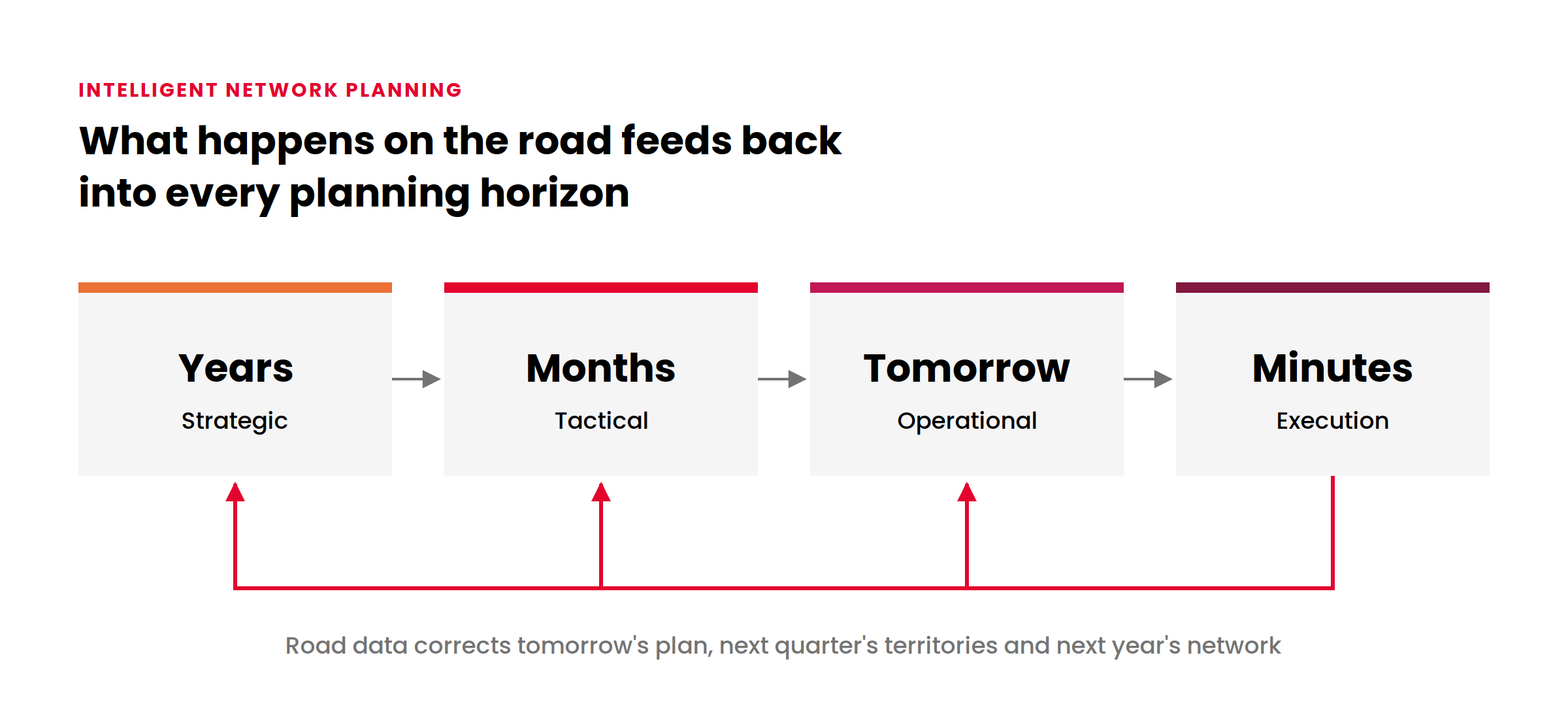
Logistics planning runs on four clocks: years, months, tomorrow and minutes. In most companies each clock has its own tool, its own team and its own spreadsheet, and none of them talk to each other. Intelligent network planning connects them through a shared memory.
| Horizon | Planning level | Typical questions |
|---|---|---|
| Years | Strategic | Where should depots sit? How big should the fleet be? |
| Months | Tactical | How should territories and sectors be drawn? How is the fleet spread across sites? |
| Tomorrow | Operational | What does the plan for the day look like?
|
| Minutes | Execution | Where does the day stop resembling the plan?
|
The consultant owns the first clock. Sofie owns the last two. In a connected setup, what the road reports at minute level corrects tomorrow’s plan, reshapes territories next quarter and informs the network question next year.
Today that memory rarely exists. The plan goes out, the day happens, and nothing comes back.
How can you test a new depot before you open it?
You replay your real history with the new depot in it, which is the most reliable way to test any distribution network design decision. Imagine the board asks whether to open a depot in the south. The traditional approach asks what would theoretically happen, works it out on averages and produces something that looks defensible on a slide and unrecognizable to Sofie.
The operational engine asks a sharper question: what would actually have happened last month, with our real orders, our real trucks and our real constraints, if that depot had already existed?
Instead of a forecast you have to take on trust, you get last month (or last year) replayed. That gives a far higher level of confidence, and you only get it when the strategic question runs on the operational engine. As An put it, answering network questions at that level of detail used to be out of reach. Today it is possible, so there is little reason to settle for less certainty.
Why do territories and depot boundaries cost so much money?
Tactical decisions sit in a gap where nobody is looking, and that is where money quietly leaks away. Everyone is good at today, because today, we have systems. Everyone is calm about next year, because next year has consultants. The weeks and months in between have neither.
Somewhere in your network there are depot boundaries drawn years ago by someone excellent at the job, who has since retired. It was a big exercise, so nobody wants to touch it. Those boundaries were roughly right in March. By July they are comfortably wrong, and nobody notices.
Which customer or postal code is served from which depot, how territories are shaped, how a mixed fleet is spread across sites: these are quarterly questions. With one engine, your own team can answer them every quarter without extra tools, and logistics network optimization becomes a routine task for the people closest to the operation. Nothing is built and nothing is bought. A line moves on a map.
If you are not sure whether your own boundaries have drifted, these signs that your delivery network needs a redesign are a good place to start.
Why does the plan keep making the same mistakes?
Because most planning systems record what a planner changed and nothing about why. Every morning Sofie adjusts the plan, and she is nearly always right. She knows one customer’s loading dock only fits a small truck. She knows another closes early on Fridays, that a market fair blocks a street on Wednesday afternoons, and that a certain driver needs to be home on Tuesdays.
The system sees the change, forgets the reason and makes the same mistake the next day. When Sofie retires, 22 years of local knowledge walk out of the building with her.
The road tells the same story. Drivers resequence stops and know exactly how long each one really took. At best the system sees the deviation, but it never learns the cause, so tomorrow’s route goes out with the same assumptions, entirely confident.
Nobody did anything wrong. What is missing is a way for the planner, the road and the plan to learn from each other. A planning model that captures the intent behind a manual change, and puts execution data next to the plan, can avoid repeating the mistake.
What does a network planning model need before you can trust it?
Three things, and An called all three non-negotiable. Miss any one of them and the answer never survives contact with the depot:
- Every operational constraint is in it. Real time windows, real traffic, your vehicle types, driver rules, loading realities and SLAs. No averages.
- It runs in the same tool as the daily plan. One model and one data set, with nothing rebuilt for the study and nothing translated back afterward.
- Your own experts run it. People like Sofie, who use the tool every day and already carry the constraints in their heads. With a conversational, AI driven interface, even your CEO can ask the question. Network planning becomes a capability you own instead of an engagement you book.
What can you ask once those three are in place?
Any question, on any horizon, which puts supply chain scenario planning in the hands of the planners themselves. Because the engine that builds tomorrow’s routes keeps all of its daily complexity when you point it at next year. One can ask:
- What if volumes grow 20%, or 10% in one region?
- What if we open a new region or a new sales channel?
- What do our peak weeks really look like, modeled as peak weeks instead of averaged away?
- If we push this network hard, where does it take on water first?
Every scenario still respects time windows, capacities, driver hours, traffic and SLAs, because it is the same solver that has to make tomorrow work. Simplifying the problem to fit a strategic tool is what produced the drawer full of reports.
How long does it take to choose 60 depots out of 200?
In An’s own test with PTV Mira, about six minutes. The question came from a real conversation. After an earlier Leaders in Logistics session, a network manager at a large postal company told her that a series of acquisitions had left them with 200 depots. That was far too many, and his boss had asked him to select 60. Could the system handle it?
As a mathematician, An knew the answer would be a monster number. Choosing 60 locations out of 200 candidates gives roughly 7 × 10⁵¹ possible combinations: a seven followed by 51 zeros.
To make that tangible, she offered a thought experiment. Give every person on Earth a supercomputer, start them all at the Big Bang and let each one check a billion billion combinations every second. Today, 13.8 billion years later, they would be 0.00005% done.
So nobody, whether a planner, a consultant or a supercomputer, can simply try every option. You need an engine that knows where to look.
What the test looked like
On the train home, An typed the question into PTV Mira, working on a sample data set instead of the customer’s data. She asked for three scenarios at once: the best 40, 50 and 60 depots out of 200, with depot capacity and throughput constraints included.
- About two minutes after the question, all three scenarios were running in parallel.
- The full conversation and analysis took around six minutes.
- Follow-up questions, such as the average volume per depot in each scenario and how the scenarios compare, were answered in the same conversation.
Left to run for ten minutes, the engine refines the result further. No consultant, no data project, one conversation, led by the person who runs the network.
Here is an example of the same kind of question on a different network:
The video here shows the same kind of question on a different network. A planner asks PTV Mira where to add a depot in a Belgian logistics network, and which existing depot could go. PTV Mira first spots the long, expensive routes that push up the cost per stop. It then tests several candidate depot locations at once, from the coast to the Luxembourg border, and ranks the scenarios by cost, distance and operational impact. One result stands out: an existing depot that can be removed altogether. The best scenarios bring lower costs, fewer vehicles and fewer kilometers driven.
The preparation that used to take a team weeks (historical data, simulation runs, result analysis, growth scenarios) is generated and run for you. Sofie can test ten versions of her own network before lunch, without booking anybody.
PTV Mira is an interactive logistics intelligence agent that turns questions into real optimization runs, compares scenario alternatives and explains the results. It supports decisions without replacing them: users approve every action and stay in control.
Why trust a conversational planning tool with network decisions?
Because the conversation sits on top of decades of optimization calibrated against real operations. The lifeboat looks small, An said, but underneath it is anything but. AI has made building an optimizer quick. It has done nothing to shorten decades of calibration on real life cases.
Knowing where to look in 7 × 10⁵¹ options is exactly what that calibration buys you.
Where is intelligent network planning heading?
The engine is only as good as the reality it is fed, so the next step is catching the signals most companies throw away every day. An described a roadmap in which PTV Mira learns from three sources:
- the manual changes planners make every day
- feedback from execution on the road
- the scenarios teams run each week or month
The system will first suggest changes based on those patterns. Once users trust the suggestions, it can automate them, and it gets smarter with every day it is used.
An compared this with the early movers in autonomous driving, who started collecting road data long before anyone else and became very hard to catch.
“A feature can be copied. Usage and knowledge accumulation cannot.”
What should logistics leaders do now?
Close the gap between plan and execution, and ask every tactical or strategic question on your operational data and operational model. The technology to do that is available today.
Within one to three years, resilience will mean acting in the moment, whenever needed. Reacting well will no longer be enough. The danger of staying on the ship is hard to see at first. It shows up slowly, as a competitor who redraws territories around its depots every week or month while you replan every few years.
By the time staying feels as dangerous as leaving, the best boats are gone. The companies that start now will have a model that gets smarter every week.
“Nobody is asking you to jump into the ocean. Just to step into the boat while the lights are still on. One foot at a time.”
Trucks run on diesel. Network planning runs on data. See how PTV Mira answers network questions on your own operation. Reach out to us for a demo.
Frequently asked questions
What is supply chain network design?
Supply chain network design decides where depots and warehouses sit, how many you need, which customers each one serves and how goods flow between them. Traditionally it is a periodic study built on average volumes and costs. Intelligent network planning runs the same questions on the operational model, with every real constraint included.
What are the benefits of supply chain network design on an operational model?
The answers survive contact with the depot, because they respect real time windows, traffic, vehicle types and driver rules. You can test a decision by replaying last month’s real orders, your own planners can revisit territories every quarter, and scenarios run in minutes or hours instead of weeks.
What is transportation network optimization?
Transportation network optimization finds the best combination of depots, territories, fleet and routes to serve demand at the lowest cost within your service levels. The number of options grows fast: choosing 60 depots out of 200 candidates gives roughly 7 × 10⁵¹ combinations, so an optimization engine has to know where to look.
How often should you review your logistics network?
More often than once a year. In An De Wispelaere’s view, depot boundaries and territories are quarterly questions, and the network itself should be reconfigured continuously as execution data comes in. When planning runs on the same engine as daily operations, a review becomes a conversation instead of a project.