

Moving from single depot route planning to multi depot logistics planning is a major step for any growing company. In a single-depot setup, your route planning is all about finding the best sequence of stops from one starting point. In a multi-depot setup, you face more choices before routing even starts. Which depot should serve which order, with which vehicle, under which time window, at what cost, and with what effect on the rest of the network?
Many small businesses start out using spreadsheets, a basic TMS tool, or A-to-B navigation and map tools for their route planning. Those work for a while, but eventually fail to keep up with the complexity and scale of larger operations.
If you are currently expanding to a multi depot network or simply facing one of the many common depot planning challenges, this article can help. It covers day-to-day, practical differences between single depot vs multi depot planning, and shows you how multi depot optimization software can make many tasks easier and more efficient.
When single depot route planning works
Single depot route planning is the ideal solution for many businesses. You are probably familiar with this type of logistics if:
- Your company has one warehouse or dispatch point
- You deliver within a relatively small geographical area
- Incoming order patterns are predictable
- Your fleet consists of one type of vehicle
- Your service commitments are manageable
- There are very few exceptions within your normal logistics operations
This kind of operation often values speed, simplicity, and low overhead. If exceptions or escalations occur, your team can manage them by hand, because the volume is not too high. There is no need for depot assignment, because there is only one actual origin point for all your routes.
In a single depot network, if you want to optimize logistics (to lower costs, emissions, or empty miles, for example), your main option is to find the best sequence of stops for all your routes. You might also try to speed things up by buying more efficient vehicles or moving your single depot to a different location, but options like those usually add too much overhead, especially for small companies.
How multi depot logistics planning is different
As your business scales up, your logistics team usually experiences three major changes that demonstrate the difference between multi depot vs single depot distribution:
- More locations: You open up more depots. In retail, stores may start serving as local fulfillment points. In CEP, the network may expand into a new region. For 3PLs, growth often means serving customers with different service footprints and cut-off times.
- More constraints: Same-day and next-day delivery promises tighten time windows. Vehicle types become more diverse. Some deliveries need smaller vans for city access, while others require heavier vehicles, ADR compliance, refrigeration, or special unloading capacity. Truck-specific routing starts affecting which depot and which vehicle should serve which job.
- Heavier workload: Orders no longer fall neatly into fixed depot buckets. Planners start making manual overrides, moving orders between depots in spreadsheets, and rebalancing workloads through emails, phone calls, and late changes. Shadow planning processes grow outside the TMS because the system cannot answer the real question of how to plan routes from multiple depots in the best way today.
At that point, it is time to pivot from single depot route planning to multi depot logistics planning.
The hidden costs of moving to multi depot logistics planning too slowly
Many companies struggle to update their logistics when the time comes to switch to a multi depot approach. In some cases, they may in fact be operating from multiple depots, but still use the same planning tools and strategies as when operations were still running from a single depot. This brings hidden risks and costs that ultimately slow growth and harm your business:
Extra miles build up when orders keep going to familiar depots instead of the most efficient one.
- Fuel costs rise because planners cannot easily rebalance loads and capacity across the network.
- Overtime increases when one depot gets overloaded while another still has room to absorb more work.
- Late deliveries become more likely when time window constraints in multi depot route planning are handled manually and too late in the day.
- Planner productivity drops because teams spend hours forcing network complexity into spreadsheets and tools built for single-depot operations.
- Instead of focusing on service quality or real exceptions, planners get stuck managing avoidable manual work.
This is usually the point where basic tools stop being enough, because planners face new complexities and decisions about how to run a multi depot network well.
What makes multi depot route planning so complex
In a multi depot environment, planners must decide which depot should serve each order, then determine which vehicle, driver, and route make the most operational and commercial sense. They have to account for many factors and constraints, including:
- customer time windows and service-level commitments
- driver hours and labor rules
- vehicle capacity and loading limits
- depot opening hours and dispatch cutoffs
- truck-specific constraints, such as height, weight, refrigeration, or urban access permissions
- local road restrictions, tunnels, bridges, low-emission zones, and city access bans
Also read: Dutch Truck Toll 2026: What’s Changing and How It Affects Your Logistics Costs
This is also where the multi depot VRP (vehicle routing problem) occurs. It is the challenge of assigning depots and orders to vehicles and sequencing stops in a way that meets operational constraints at the lowest feasible cost.
That is why multi depot optimization software needs to do more than assign jobs mathematically. It needs to reflect how planning actually works on the ground and support the daily decisions planners now have to make.
Major multi depot planning challenges and the practical fixes
When handled effectively, multi depot logistics planning can become a major competitive advantage for a fast-growing business. Still, there are major operational challenges to overcome.
Challenge #1: Assigning orders to the best depot dynamically
Many growing companies stick to static rules such as “this customer belongs to depot X,”even long after they stop making sense. They overlook factors like new depots, local congestion, changing demand, and daily capacity pressure. A better approach is to evaluate all depot options for each order and weigh distance, travel time, time windows, and capacity together.
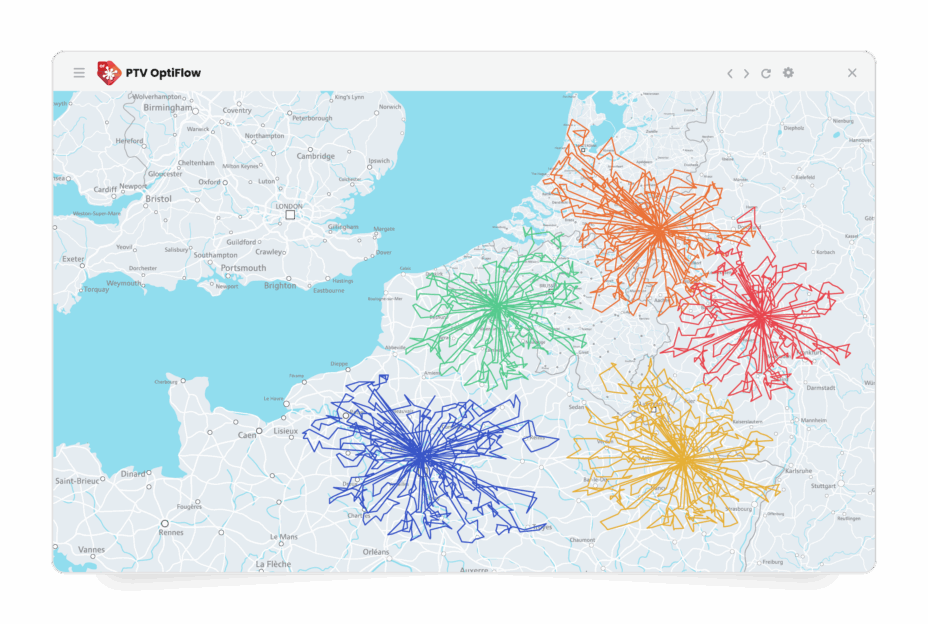
This way, operating multiple depots becomes part of your optimization strategy and more of a competitive advantage. With advanced multi depot optimization software like PTV OptiFlow, planners can evaluate multiple depot assignment options dynamically. Instead of relying on fixed allocation rules, the system weighs distance, time windows, and available capacity simultaneously to identify the most efficient assignment.
Challenge #2: Fleet balancing across multiple depots
One of the most common depot planning challenges is uneven loading across the network. One depot is stretched. Another has underused vehicles. Expensive ad hoc carriers fill the gaps. Cost per stop rises even as volume grows.
Multi depot route optimization software helps by balancing demand and available resources across the network. It can suggest when reassigning orders creates a better outcome, model the cost-to-serve by depot, and support better fleet balancing across multiple depots. That gives planners a stronger operating model and gives managers clearer budget oversight. Tools such as PTV OptiFlow support this by continuously rebalancing demand and resources across depots, helping planners reduce cost per stop while improving overall fleet utilization.
Challenge #3: Local constraints and truck-specific route planning
Different depots serve different road environments, customer profiles, and vehicle requirements. A city depot may need smaller vehicles because of urban restrictions. A regional depot may handle larger truckloads but face weight limits or narrow access roads. Hazardous goods may require trained drivers and specific equipment.
Challenge #4: Planner workload and coordination
As your networks grow, planning starts to involve a lot more data coordination. Orders come from your ERP and WMS systems. Capacity and resource data come from your TMS. Exceptions arrive by email or phone. Your telematics tools keep your team updated on execution. There are a lot of moving parts, and, without clear, unified workflows, your planners will spend too much time just looking for the information they need.
This is another area where the right multi depot optimization software makes the difference. It should fit planner workflows, not force planners to think like data scientists. It should offer clear integration paths so orders come in cleanly, plans go out cleanly, and feedback from execution can improve the next planning cycle. This is another area where solutions such as PTV OptiFlow make a difference. By integrating data from ERP, WMS, and telematics systems, it supports planners with a unified view and reduces the need for manual coordination across tools.
Ready to move from single-depot to multi-depot planning?
If your business is expanding beyond a single depot logistics network, this quick checklist can help you decide whether it is also time to upgrade your route optimization strategy by adding multi depot route optimization software to the mix.
Checklist for scaling from single depot to multi depot operations
- Do you operate from two or more depots, warehouses, stores, or cross-docks?
- Do your planners manually reassign customers between depots to fix daily capacity problems?
- Do spreadsheets sit alongside your TMS because the core logic is too rigid?
- Are costs per delivery or per stop rising despite healthy volume growth?
- Do customer time windows differ sharply across regions?
- Are you planning new depots, depot closures, or service-area redesigns?
If you answer yes to one or more of the questions below, chances are good that your team will benefit from a more software-driven approach to route optimization.
What to look for in multi depot optimization software
Not all tools that mention multi depot route planning are built for the same job.
Some are static route planners with light add-ons. Others are true optimization engines that can solve multi depot and multi-leg problems at scale. Some can display routes from multiple origins. Others can actively decide which depot should serve which demand under real constraints.
For more logistics teams, important capabilities to look for are:
- multi depot and multi leg optimization
- scenario planning for depot networks (learn more below)
- scalability for larger fleets and order volumes
- strong APIs and integration options
- usability that works for planners under daily pressure.
To ensure the quickest time to value, it is important to look for a multi depot route optimization software that specifically meets your daily operational needs.
The advantages of scenario planning for depot networks
Many teams treat logistics network design as a strategic exercise and daily route planning as an operational task. In practice, the two are closely connected. As networks grow more complex, decisions about depot locations, service areas, and capacity allocation can no longer rely on static assumptions. Scenario planning provides a structured way to evaluate these decisions by comparing alternative network setups based on cost, distance, and operational feasibility. To make this more tangible, consider how this approach works in practice:
For example, in this use case, PTV Mira, an AI-supported logistics optimization tool, evaluates a real-world depot network and tests multiple structural changes at once — including adding new depot locations and removing existing ones. Instead of relying on fixed rules or assumptions, it compares scenarios systematically to identify the most efficient network configuration.
The example highlights a few important aspects of modern depot network planning:
- Inefficient long-distance routes are identified automatically
- Multiple depot location scenarios are evaluated simultaneously
- Trade-offs between cost, fleet size, and service impact become visible
- Non-obvious insights emerge, including which depot may no longer be needed
This type of analysis reflects a broader shift in logistics planning: moving away from static design decisions toward continuous, scenario-driven optimization.
Multi depot route planning in action
The best way to understand multi depot logistics planning is to look at how it fits into your planners’ daily workflow. Orders flow in from ERP or WMS systems. The planning environment already knows available depots, opening hours, fleet resources, capacities, service types, and relevant constraints. It also knows time windows, vehicle attributes, and local routing restrictions.
The planner launches a multi depot optimization run. Orders are assigned to the most suitable depot and routes are built accordingly. The system proposes a feasible plan across the network rather than forcing the planner to decide depot allocation order by order.
The planner then reviews exceptions. A VIP customer may need a preferred delivery pattern. A subcontractor may be unavailable. A local event may affect access. Those are the kinds of adjustments planners should be spending time on.
Once the plan is approved, it moves into execution. At this stage, real-world variability comes into play — traffic conditions change, delays occur, and customer availability may shift.
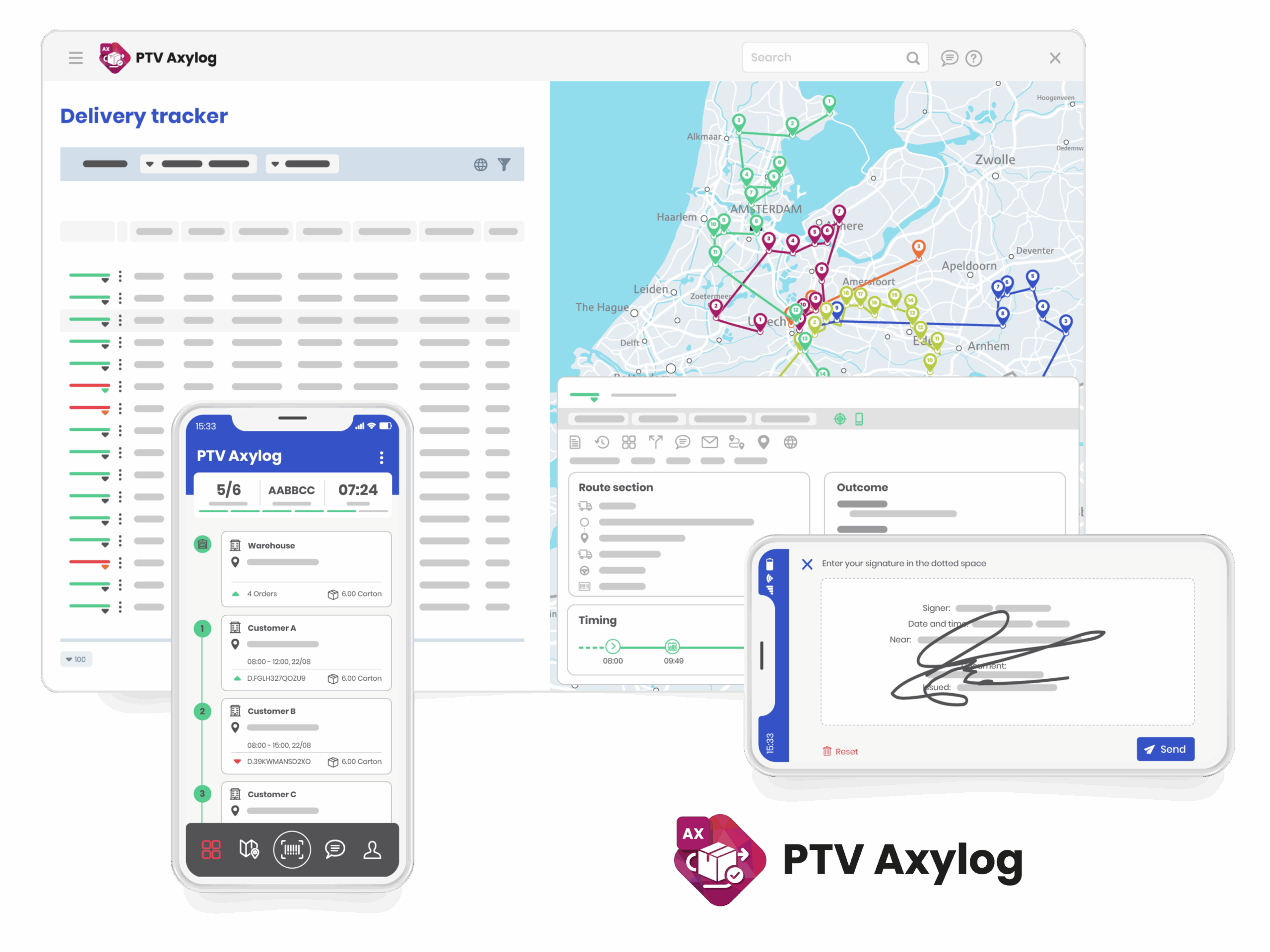
Execution tools such as PTV Axylog extend planning into the field by providing real-time visibility into route progress, delivery status, and driver activity. Dispatch teams can monitor operations as they unfold, respond to disruptions, and keep customers informed with accurate updates. This closes the loop between planning and execution, ensuring that insights from real-world performance can feed back into future optimization runs.
Moving from single-depot to multi-depot planning the smart way
Single depot route planning still works when your network is simple, stable, and centered on one origin point. But once you are managing multiple depots, tighter SLAs, mixed-vehicle fleets, and fluctuating demand, you quickly run into a new set of challenges. At that stage, trying to manage multi depot routing challenges with single-depot logic usually creates waste, planner overload, and avoidable service risk.
Switching to multi depot logistics planning does not need to be overwhelming. With the right approach, it gives you better control over depot assignment, fleet balancing across multiple depots, time window performance, and network-wide efficiency. It also gives you a practical way to test future changes before they disrupt operations.
If you are comparing single depot vs multi depot setups, think about whether your planning model still fits the network you run today? If not, optimization-first tools of PTV Logistics can help you scale, simulate, and plan more efficiently.