
Retail and last‑mile logistics have never been more complex. Delivery windows are tightening, customer expectations are rising, and operational networks are expanding in every direction. At the same time, leaders must balance cost pressures, sustainability targets, and the need for consistent service quality across increasingly dynamic environments.
In this landscape, planning is no longer a back‑office function but a strategic engine. To explore how organizations can turn complexity into competitive advantage, we spoke with Thomas Greiter, Chief Commercial Officer at PTV Logistics, about the major shifts shaping the industry and why many retail, CPG, and last‑mile operators are rethinking how they approach routing and delivery optimization.
How are rising complexity and customer expectations reshaping retail and last‑mile logistics today?
“Retail and last‑mile logistics are incredibly demanding ecosystems. What advanced planning and optimization technology enables is real control over that complexity. It transforms what feels overwhelming into a system that can be optimized, measured, and continually improved.
Today’s delivery networks must account for far more than routing alone. Leaders are dealing with dock congestion, fluctuating loading peaks, intricate tariff structures, unpredictable urban traffic, and the rising need to coordinate pickups and deliveries in a single, efficient flow. These are no longer edge cases — they’re daily realities that shape service levels, operational predictability, and cost structures. When leaders gain visibility and accuracy at that scale, they can consistently hit service levels while protecting margins.”
“The real value is resilience. Leaders get a predictable, efficient, and future‑proof network — not just a better plan for tomorrow morning.”
How should leaders think about the role of advanced route optimization in building agile and cost‑efficient delivery networks?
“Companies don’t fear innovation; they fear making the wrong decision. That’s why evaluating planning technology cannot be hypothetical. Leaders want proof that an optimization engine can handle their real operational complexity. The most effective platforms are those that model real‑world constraints with high fidelity — urban access rules, narrow delivery windows, cooling requirements, fleet mixes, dock availability, and even complex pickup‑and‑delivery flows. In high‑density networks, these are not exceptions; they are the daily mechanics that determine whether a plan is truly executable.”
A modern, cloud‑native architecture is equally important because it removes infrastructure burdens and accelerates time to value. And when planners see that automation enhances rather than replaces their expertise, adoption becomes significantly smoother. Consistency improves, and the organization gains the agility it needs to respond to fluctuating demand with confidence.”
Did you know?
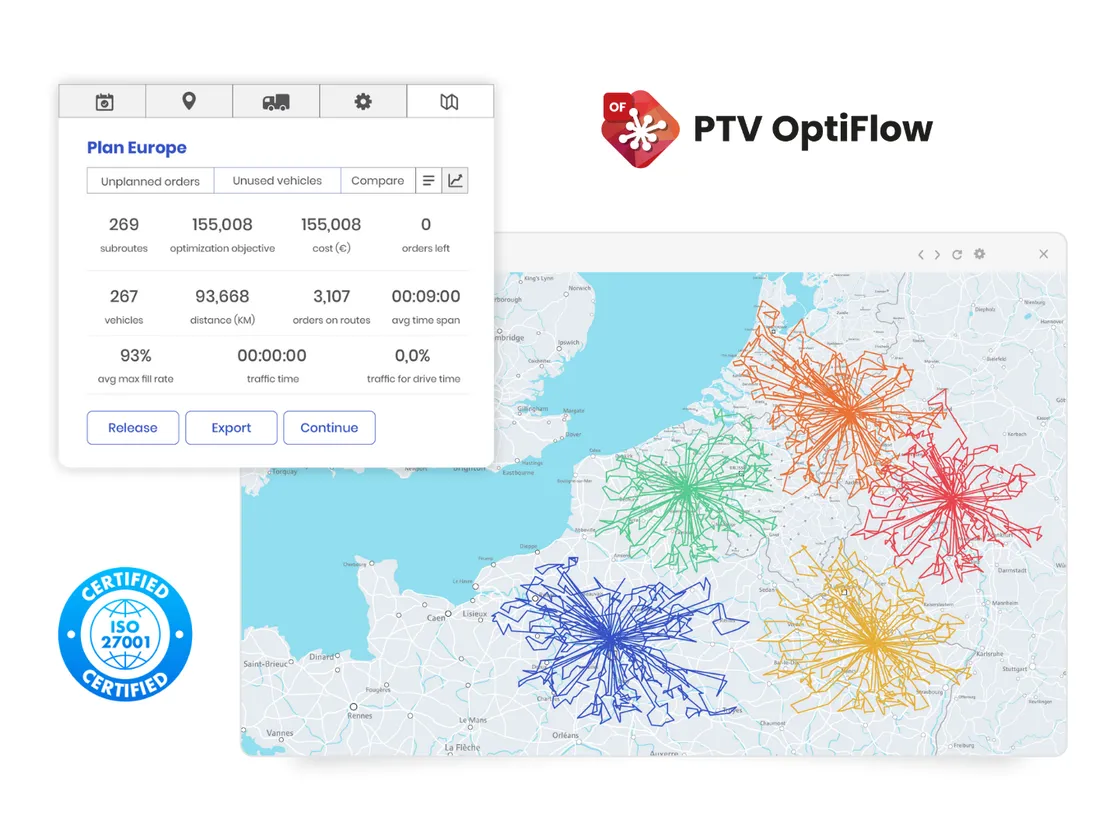
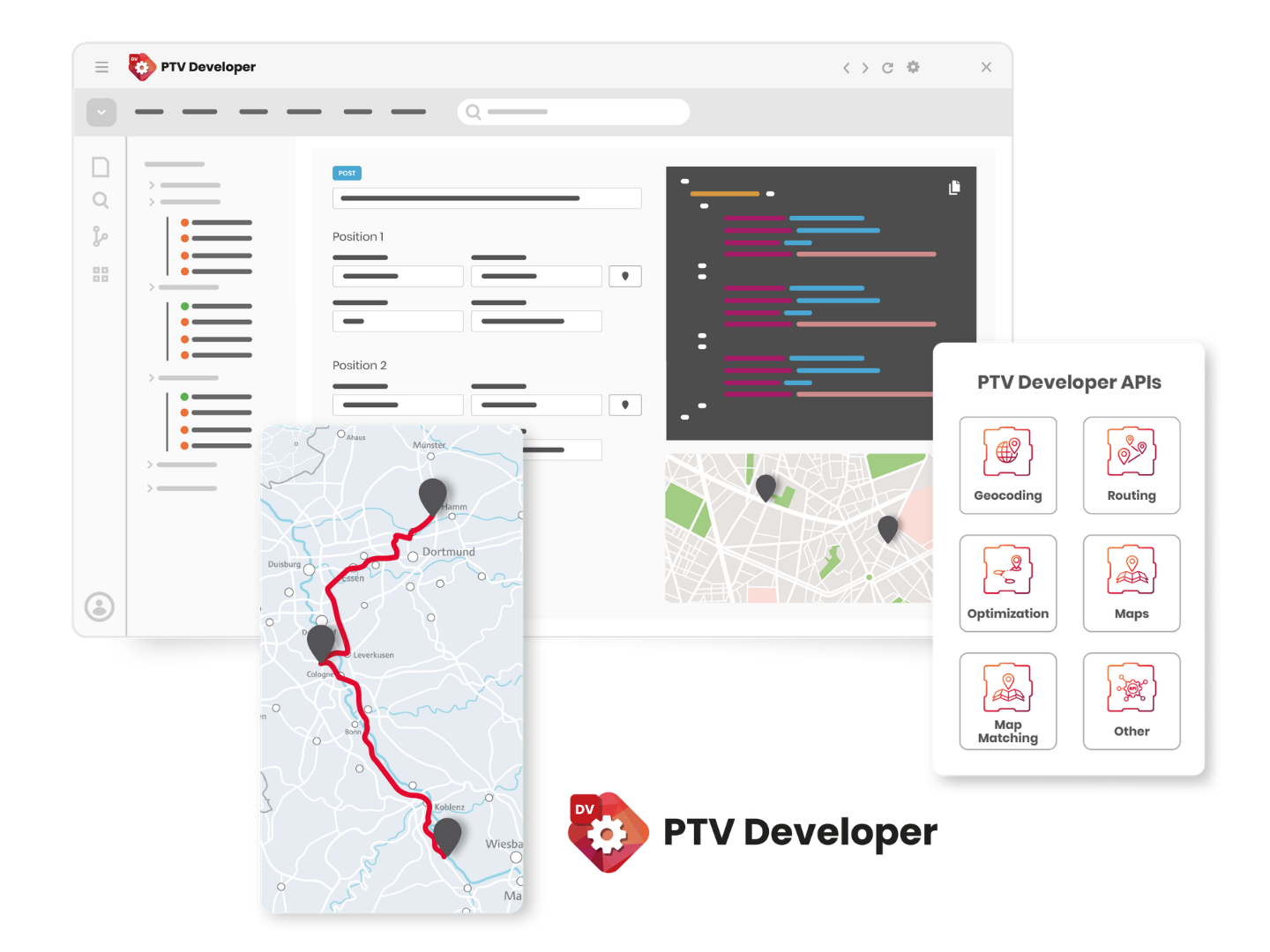
PTV OptiFlow can optimize over 15,000 orders per run in its cloud-native SaaS environment, and scale to more than 50,000 orders when using the PTV Developer API — all within one centralized optimization flow.
What barriers do organizations typically face when adopting new planning or optimization technology?
“Internal adoption is always one of the biggest questions: Will teams embrace automation? Will it reflect their operational reality? And will the ROI be clear enough for leadership?
That’s why we work with real operational data right from the start. When companies see their own routes, constraints, KPIs, and service requirements optimized through an advanced engine, the conversation shifts from uncertainty to clarity.
Modern planning technology isn’t just about introducing efficiencies; it’s about building confidence across the entire organization.”
How are retailers and logistics operators scaling sustainably through smarter planning?
“Real‑world results tell the story best. When companies standardize their planning and automate the complexity, the impact is immediate and measurable.
Take ID Logistics, for example. They centralized planning across seven depots and now run their entire evening operation with just two planners managing more than 400 routes and up to 6,000 stops. That level of productivity simply wasn’t possible before and the gains extend beyond time savings. They’ve reduced kilometers driven and improved route consistency across the network.
Crisp, the B Corp‑certified online supermarket in the Netherlands, is another great example of how smarter planning supports both growth and sustainability in last‑mile delivery. They operate a highly complex, time‑slot‑driven model with electric vehicles and city hubs. By using automated, data‑driven route planning, they’re able to balance service and efficiency. The result is 11% less driving time, 23% fewer kilometers, and 13% lower transport costs, while still delivering over 95% of orders on time — all in support of their ultra‑fresh, low‑waste farm‑to‑fork model.
Together, these cases show that when planning becomes automated, data‑driven, and aligned with operational reality through platforms such as PTV OptiFlow, it transforms not just routes but the performance of the entire network.”
When you speak with C‑level leaders, what capabilities do they consistently look for in high‑performance optimization platforms?
“Three capabilities always rise to the top:
- First, performance at scale. Large networks need reliable speed and precision. Many tools can handle small scenarios; few can manage thousands of orders across multiple depots without delays.
- Second, true automation. Leaders want systems that optimize based on KPIs: cost, service levels, utilization — freeing planners from repetitive manual adjustments and allowing them to focus on strategic decisions.
- And third, economic intelligence. Optimization must reflect the company’s real P&L structure. It’s not enough to calculate the shortest route — it needs to calculate the smartest route for the business.
That’s why platforms like PTV OptiFlow resonate so strongly with executive teams — they translate operational complexity into measurable business impact. And that distinction is exactly what leaders are looking for today.”
How is decision‑making in logistics evolving beyond traditional dashboards and reports?
“Logistics leaders are increasingly realizing that having data is not the same as having clarity. Traditional dashboards show what happened, but they often fall short when leaders need to understand why something is happening or what to do next. What we’re seeing is a shift toward decision‑making intelligence. Leaders want to explore scenarios, ask real operational questions, and understand trade‑offs between cost, service, and sustainability before committing to a decision. That requires more than static reports — it requires interaction.
This is where conversational, AI‑driven decision support becomes powerful. Instead of navigating complex tools or running manual analyses, leaders can ask questions in plain language, explore what‑if scenarios, and instantly see the impact of different choices — whether that’s adjusting delivery times, responding to disruptions, or evaluating strategic changes like depot locations or fleet transitions.
Also Read: AI in Route Optimization: From Algorithms to Decision Intelligence
With solutions like PTV Mira, that intelligence is directly connected to real optimization engines. It doesn’t just describe the data — it runs real simulations, compares alternatives, and explains the results clearly. The outcome is faster, more confident decision‑making, with transparency around why one option performs better than another.
Importantly, this doesn’t replace planners or decision‑makers. It supports them. The final decision always stays with the human — but it’s informed by deeper insight, clearer trade‑offs, and far less manual effort.”
What major shifts do you believe will define the future of retail and last‑mile delivery, and how should logistics leaders prepare?
“We’re seeing several major transformations. Urban density is rising, sustainability regulations are tightening, and customer expectations for precision and transparency continue to grow. Planning teams are under immense pressure to deliver more — often with fewer resources. Leaders who invest in automation, predictive analytics, and adaptable delivery models will have the advantages. The future isn’t about reacting faster; it’s about planning smarter with real-time insights and reliable optimization. Organizations that make this shift early will be far better positioned to compete.”
For organizations evaluating new planning technology, what is the most effective way to assess potential impact?
“Start with one real operational day — ideally the day that stretches your network the most. We compare your existing plan with an optimized output based on your own data, constraints, and KPIs. This side‑by‑side comparison reveals savings in kilometers, hours, and costs, and shows improvements in service level and planning consistency. It also brings planners, operations teams, and leadership together around the same evidence.
Executives don’t need more slides — they need clarity. And clarity comes from seeing what advanced planning technology can do with their own data. When organizations test their operational day through PTV OptiFlow, the difference in efficiency, cost alignment, and planning quality becomes immediately visible.”
We’re hearing more about concepts like network design, optimization, and smart sectorization coming together. How should logistics leaders think about this more holistic approach?
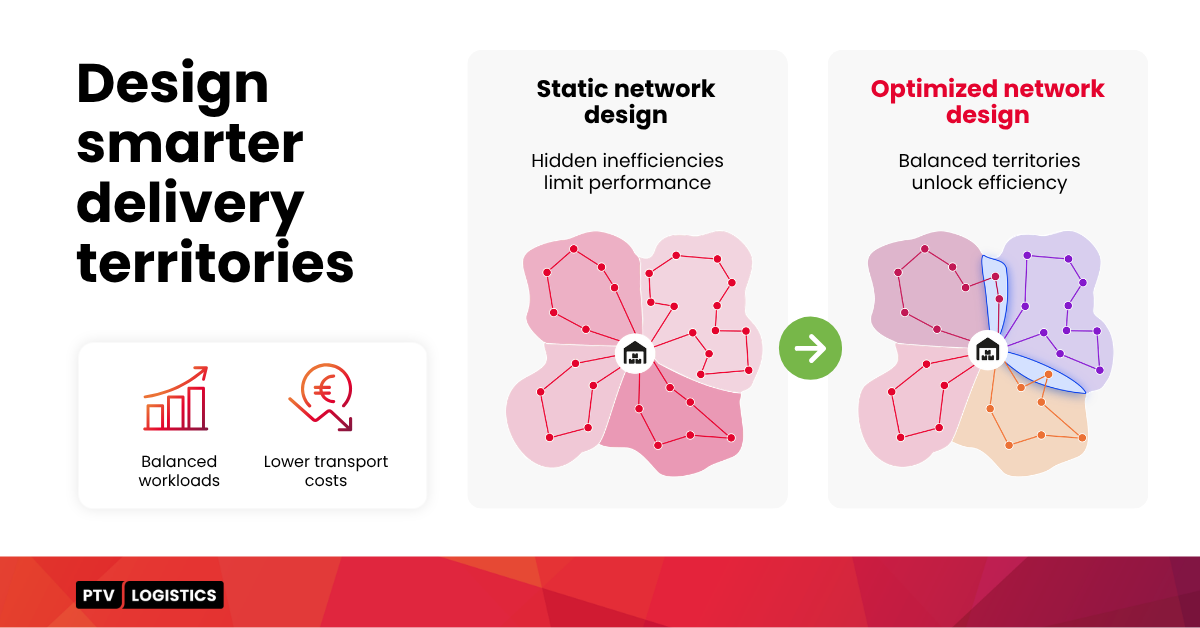
“What we’re seeing is a clear shift from isolated optimization to end-to-end network intelligence. Route optimization alone is no longer enough if the underlying network structure and service territories aren’t designed to support it.
Leaders are starting to think in three interconnected layers.
- First, network design — where should depots, hubs, and service points be located to balance cost and service levels?
- Second, optimization — how do you execute daily planning in the most efficient way based on real operational constraints?
- And third, smart sectorization — how do you divide service areas into territories that are balanced, adaptable, and aligned with demand?
When these elements work together, the impact is significant. You reduce unnecessary mileage, improve workload distribution, and create a system that can adapt dynamically to changes in demand, traffic, or capacity. What makes this particularly powerful today is that it’s no longer a static, one-time exercise. With modern platforms, companies can continuously simulate scenarios, adjust territories, and refine their network as conditions evolve.
That’s ultimately the difference we’re seeing: organizations moving from reactive planning to strategically designed, continuously optimized networks that deliver both efficiency and resilience at scale.”
Retail and last‑mile networks will only become more demanding, but the organizations embracing high‑performance optimization are already proving that complexity can be turned into advantage. With measurable cost savings, reduced CO₂ emissions, centralized planning, and automation that scales with the business, modern optimization engines give leaders the control they need to operate confidently in an increasingly dynamic environment.
The future belongs to organizations that plan smarter, faster, and more sustainably, and PTV Logistics is helping them make that shift from indecision to impact.
About Thomas Greiter
Thomas Greiter is Chief Commercial Officer at PTV Logistics, where he leads commercial strategy and global growth. He has more than 20 years of experience in logistics and transportation technology, including 14 years as Senior Sales Director at Transporeon and earlier roles at Dachser.