

A day in the life of a CEP transport planner is all about managing complexity, where last mile delivery planning meets the reality of driver shortages and shifting time windows. While many focus purely on routing, true courier dispatch planning workflows require a delicate balance of high-density stop sequences and real-time execution.
Inside a CEP Network: What a Transport Planner Really Manages
More than managing dots on a map, a CEP transport planner deals with an ecosystem of numerous routes that must be synchronized with rigid SLAs, multi-depot constraints, and the unpredictable volatility of the morning’s parcel volume.
From parcels to promises: the CEP planning context
In the world of last mile delivery planning, a shipment represents a contractual promise. CEP-specific realities, such as high shipment volumes, dense urban stops, and tight SLAs, mean that planners’ margins for error are extremely tight. They are also ever-changing, involving multi-depot and micro-hub structures, fluid inventory levels, and peak season spikes, meaning service changes are the norm.
The role of the CEP transport planner
A CEP transport planner’s day is spent balancing theory and reality. Their key responsibilities include building routes, assigning drivers and vehicles, and coordinating depots, as well as managing constraints and exceptions.
Measuring various KPIs can help ensure planners are meeting objectives and making good on service promises, including on-time performance, drop density, km per stop, driver overtime, and customer satisfaction levels. With research showing that 91% of consumers actively track their packages, even a ten-minute deviation from the plan is immediately visible to the customer – it’s essential CEP transport planners have a similarly clear view of what’s happening across their network.
Morning: Turning Overnight Orders into Feasible Routes
Overnight orders can pile up so that, by the morning, a CEP transport planner is left facing a chaotic list of addresses and a mountain of data.
Data intake – orders, depots, and constraints
The planner’s first tasks involve importing or receiving orders from their TMS/WMS, checking volumes per depot, and reviewing special delivery requirements. Constraints to consider include time windows and service levels, vehicle capacities (weight, volume, compartments), driver shifts (working-time regulations), and truck-specific restrictions (low bridges, banned streets, and emission zones).
Some of that morning data arrives thin — a postcode with no street address, for instance and even automated geocoding can place it in the wrong spot, especially when a postcode spans several neighbourhoods with no obvious centre. PTV Developer’s Geocoding & Places API now resolves this, returning a point that reflects where people and businesses actually are rather than a mathematical midpoint.
For a planner, that means volumes per depot and delivery zones are built on accurate coordinates from the first import, instead of needing a manual correction later in the day.
Building the first optimization run
Traditionally, a planner would rely on legacy tools, such as spreadsheets or generic map tools, meaning hours spent manually clustering destinations – all of which could be undone in one swoop by an unexpected disruption like a single road closure.
In contrast, a planner’s day is transformed through optimization-first software – PTV OptiFlow customers typically see planning time cut by 60-80% compared to manual methods.
With PTV OptiFlow, CEP transport planners benefit from:
- Automatic clustering by depot/region.
- Constraint-aware route optimization that generates an initial, feasible plan for thousands of stops.
- Visualization on a digital map to check obvious issues (e.g., overloaded routes or impossible time windows).

Fine-tuning routes with planner expertise
Optimization doesn’t mean handing over the reins to technology completely. The true value of a courier dispatch planning workflow comes from the synergy between the digital solution and the local expertise of the planner. In fact, 2026 EY industry benchmarks show that while AI can cut delivery times, it is the human oversight – preferred by 66% of logistics leaders – that bridges the gap between a mathematically perfect route and a realistically executable one.
- Planner adjustments: Local driver knowledge means specific roads can be avoided and VIP customers with bespoke demands can be catered for.
- Workflow simplicity: Using PTV OptiFlow’s intuitive interface, planners can drag and drop route changes, receiving instant recalculations and gaining clear visibility into the impact they’ll have on time windows and workload.
This is the same philosophy behind PTV Mira: the tool should do the heavy math, leaving the planner in control. Built on more than 40 years of optimization expertise, PTV Mira is designed as decision support, not decision replacement — a way to strengthen human intuition with a data-driven foundation, not override it.
Learn more about how PTV Mira supports strategic decision-making here.
Late Morning to Midday: Execution, Visibility, and Exception Handling
Once the plan is finalized, the time for theory ends and the physical reality begins. In the high-velocity CEP world, the transition from a digital route to a moving vehicle must be instantaneous and error-free.
Dispatching routes and aligning depots & drivers
For a CEP transport planner, this bridge between planning and execution relies on synchronization. It depends on confirming routes, assigning vehicles and drivers, and sharing plans with depots. Execution also means understanding exactly how plans transition to the road through various software integrations, including TMS, telematics, and driver apps.
Real-world disruptions and how planners respond
In an ideal world, the morning plan would remain viable throughout the day. In reality, this is rarely the case. Typical CEP disruptions include:
- Traffic congestion, accidents, and road closures.
- Last-minute orders or cancellations.
- Driver sickness or vehicle breakdowns.
- Missed loading windows.
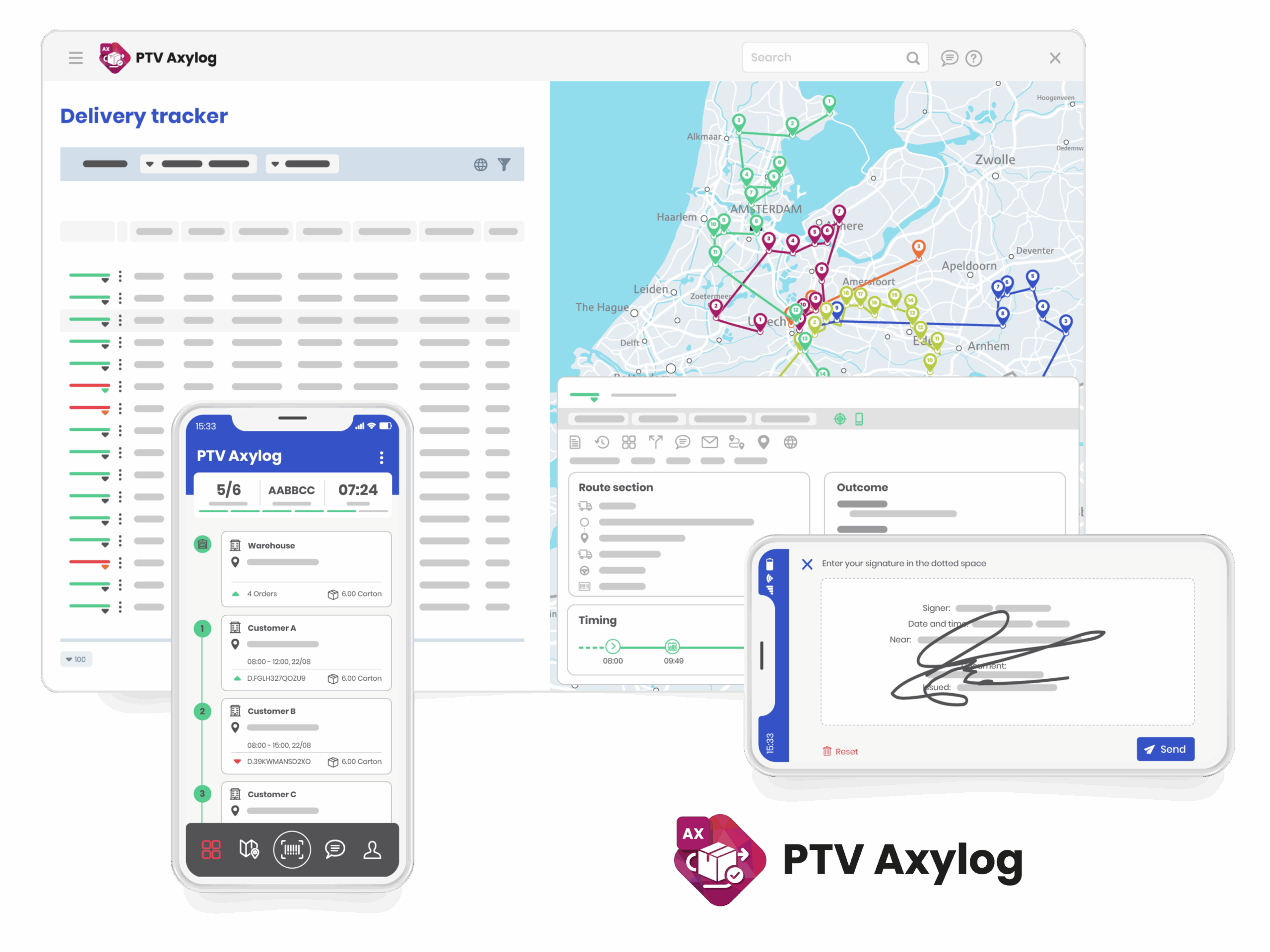
Disruptions needn’t cause disaster, however – and this is where tools like PTV Axylog come to the fore. With PTV Axylog, planners gain proactive, road-centric visibility:
- Real-time view of route progress vs. the plan.
- Alerts for potential missed time windows, so a planner can react before a customer notices.
- Automatically updated ETAs pushed to depots and driver apps as conditions change.
Micro-replanning workflows
When disruption occurs, high-volume route planning software allows for micro-replanning – fixing the broken part of the network without manual recalculation of the entire fleet. Step-by-step, this looks like this:
- Identify a problem (e.g., a delayed vehicle).
- Run a partial re-optimization on affected routes.
- Reassign stops to nearby vehicles while respecting time windows and capacity.
- Communicate updated ETAs to stakeholders/customers.
While a human might struggle to identify which of 50 nearby vehicles is the best fit for an additional five deliveries, an optimization engine can evaluate thousands of combinations in seconds. The planner simply chooses the best scenario.
Afternoon: Reporting, Continuous Improvement, and Scenario Planning
As more and more parcels reach their destinations, the transport planner’s focus shifts to what comes next – evaluating the day and planning for tomorrow.
Closing the day: KPIs and performance review
The workday isn’t over when vehicles return to the depot; it ends when the data is reconciled. The planner then validates the day’s performance against their original plan.
The planner checks:
- On-time delivery rates.
- Average km per stop.
- Driver overtime and route balance.
PTV Axylog’s real-time visibility carries through into this reconciliation, giving planners a clear view of planned vs. executed routes without piecing the day back together by hand. Recurring patterns – a depot that’s chronically slow to load, a zone where deliveries run late more often than they should, surface here too, so planners know exactly what to fix before it repeats.
From daily troubleshooting to continuous optimization
Before implementing route optimization software, a CEP transport planner’s afternoon could easily have been lost answering customer emails about missed deliveries. Now, that time can be reclaimed for analysis.
For a CEP transport planner using PTV OptiFlow, a recurring bottleneck – a zone that runs late, a depot that’s slow to load – doesn’t have to stay a mental note passed from one shift to the next. It gets fed straight back into the plan, so tomorrow already accounts for it.
Over time, that shows up as:
- Fewer km driven.
- More drops per route.
- Reduced planning time per day.
- Less dependency on a single “hero planner”.
Scenario simulation and network design for CEP
Planners can also leverage PTV OptiFlow to perform “what-if” simulations without risking live operations, adjusting CEP network design to incorporate longer-term tasks, such as:
- “What happens if we open a new micro-hub?”
- “Can we offer a new two-hour delivery window in a city?”
- “How do we manage peak season with our current fleet and depots?”
Before committing to any of these, a planner can also bring PTV Mira into the conversation for a fast, data-driven read on the trade-offs, while PTV OptiFlow models exactly what that decision looks like in practice – routes, depots, and drop sequences included. Together, they turn network design from a slow, high-risk guess into something a planner can test, question, and refine before it’s ever run on a live route.
For the fuller framework behind these decisions, this breakdown of the key network choices every CEP planner has to get right is worth a look.
How CEP Transport Planners Can Get Started with PTV Logistics
Transitioning from manual firefighting to an optimization-first workflow doesn’t require a total overhaul of your existing operations. PTV Logistics is designed to be interoperable and adaptive, fitting into your current ecosystem while providing a rapid path to improved drop density and lower costs.
Fast time-to-value and adoption
Just as customers want fast deliveries, CEP transport planners want fast results from their route optimization software. PTV OptiFlow is built for that kind of speed – its cloud-native platform and full automation are designed to plan up to 6x faster than manual methods.
Most successful rollouts begin with a single pilot depot or region, allowing planners to define their specific constraints and validate plan quality in a controlled environment. With clear visualizations and drag-and-drop adjustments, PTV OptiFlow handles the high-speed calculations while the planner maintains total control over the final output.
HelloFresh shows what that looks like at scale: operating across 18 markets on three continents, with significant volume through the Benelux region, they moved to PTV OptiFlow in 2019 to replace fragmented, manual planning. Since then, transportation costs have fallen 16%, planned kilometers dropped more than 20% compared to their previous system, and 93% of deliveries now arrive within 30 minutes of their scheduled time.
Integrating with your existing tech stack
Not every CEP operation wants to build its own routing, geocoding, and optimization logic from scratch — nor should it need to. PTV Developer exists for exactly this: a set of 17 individual APIs, spanning route optimization, truck-specific routing, geocoding, and mapping, that give developers and software teams direct access to the same routing and optimization engines that power PTV Logistics’ own SaaS products — without having to build that capability in-house. Built API-first, this means a CEP operation’s existing TMS, WMS, or ERP doesn’t need to be replaced — PTV Developer’s APIs integrate directly into it, so PTV Logistics can function as an intelligence layer within an existing ecosystem, rather than a replacement for it.
Urbify, a same-day and next-day delivery provider operating in more than 80 cities across Germany and Austria, built its delivery planning directly on PTV Developer’s APIs – powering the proactive customer communication about delivery timing that’s core to its service, and a clear example of what this integration layer looks like in a live CEP operation.
From first pilot to network-wide rollout
A typical journey with PTV Logistics is designed to ensure long-term stability:
- Start with one depot or region. Think about your most problematic delivery zone. What would it look like if you could reduce its planning time by 80% tomorrow?
- Validate planning quality and planner experience. Compare the optimized results against historical manual data to quantify the reduction in kilometers and planning time.
- Scale to additional depots and services. Once the pilot proves its ROI, the workflow can be replicated across additional depots, services, and peak season spikes.