

The need for Courier, Express & Parcel (CEP) network optimization is greater than ever. Pressure is mounting due to delivery promises, volatile volumes, and expanding geographies. While demand drives revenue, last-mile costs are rising for 84% of e-commerce businesses. When Excel is not enough for route planning, cracks appear during high-pressure periods when the stakes for profit and reputation are highest.
Smart network optimization replaces static methods with a proactive parcel delivery network design, using advanced route optimization software to align physical infrastructure, delivery territories, and sectorized routes with fluctuating demand.
In an industry where margins are wafer-thin, every network decision counts. Many parcel operators are shifting from static planning to more dynamic, data driven methods that help them stay ahead of fluctuating demand. Modern optimization tools make it possible to model scenarios, adapt routes in real time, and connect daily operations with long-term strategy.
From routes to networks: What “smart network optimization” really means in Courier & Parcel Operations
Beyond daily routing – the network context
True smart network optimization is not a one-size-fits-all solution; it is a multi-layered approach that synchronizes long-term strategy with minute-by-minute execution. To master the CEP network optimization landscape, planners must distinguish between two critical levels of intelligence:
- Tactical/strategic network design
Before a single van leaves your depot, the physical architecture of your business must be in good condition. Optimal parcel delivery network design involves determining the right locations for your hubs, depots, and line-haul routes, strategically positioning assets based on geographic distance, historical data, scenario planning, and existing capacity. - Operational route planning
Once the where and why of your parcel delivery network is determined, it’s time to move on to the how and when of your operations. Here, the right parcel delivery route planning software can help with managing daily execution. Whether you’re coordinating hundreds of vehicles across multiple locations, mapping last-mile network optimization against strict customer SLAs, or evaluating different vehicle types in your fleet, smart network optimization depends on being crystal-clear regarding every asset and every stop on your routes.
Bridging the gap between your strategy and the street
Smart network optimization is unique because it refuses to treat network design or route planning as separate silos. Tools like PTV OptiFlow provides a multi-depot, multi-leg, and constraint-aware planning environment that covers the entire lifecycle of a parcel. It enables CEP planners to continuously optimize territories, balance sectors, and adapt routes as volumes, service levels, and constraints change. This helps courier, express and parcel planners transform static plans into dynamic, self-correcting operations, with a view that is both holistic and granular.
The building blocks of a Courier, Express and Parcel network
Modern parcel delivery network design consists of various interconnected parts such as:
- Depots, hubs, and sortation centers
The physical transport footprint defines how parcels move through the network. Planners must decide where depots, hubs, and sortation locations should sit to balance distance, capacity, and service commitments. These decisions shape network resilience and long‑term scalability.
- Line-haul legs between hubs
Line‑haul connections determine how efficiently parcels travel between network nodes. Key considerations include direct versus multi‑leg flows, departure timing, and alignment with downstream operations. Well‑designed line‑haul structures reduce waiting times and improve asset utilization.
- Last-mile zones and delivery areas
Delivery areas define how work is distributed across vehicles and drivers. Static territories often struggle with demand variability and peak periods. More flexible zone definitions help balance workload while maintaining consistent service levels.
- Own fleet vs subcontractors
Most Courier, express and parcel networks rely on a mix of internal fleets and external partners. Planners must decide how to allocate volume to balance cost, flexibility, and control. These choices are critical for managing peaks, low‑density areas, and margin pressure.
- Service products
Parcel networks typically support multiple service levels, from same‑day to economy delivery. Each service places different demands on cut‑off times, routing, and capacity. Service promises must align with the underlying transport network to remain realistic and profitable.
Key Insight:
To manage the complexity of these building blocks, many Courier, Express and Parcel planners rely on a single optimization platform to keep network decisions consistent across planning horizons. Such platforms are designed to support transport‑level scenario planning by applying the same network logic to depot structures, line‑haul connections, delivery areas, and service configurations.
Want to see how this works in practice?
Explore the unified optimization platform here.
The critical decisions every CEP planner must get right
According to Fortune Business Insights, the global vehicle route optimization software market is projected to reach $16.6 billion by the end of 2026 and $44.20 billion by 2034. As the market expands, these are the core questions every CEP planner should be asking:
Which depots should serve which areas?
Decisions are no longer just about drawing lines on a map. They involve depot capacities, time windows, and the latest driver regulations. This is where smart network optimization can serve as a strategic digital twin for CEP managers, allowing them to use simulations to lower mileage, route density, and service costs.
Instead of testing operational changes on the road, planners can use parcel delivery route planning software to run what-if simulations of different zoning options. By modelling different scenarios, smart network optimization tools can lower mileage, route density and service costs.
This is where decision‑intelligence support becomes valuable.
Instead of manually interpreting simulation results, planners can ask questions like “What happens if we reassign this territory?” or “Which depot–zone setup performs best?”
PTV Mira evaluates the underlying scenarios and explains the outcomes clearly, helping planners move from insight to action faster.

How should we structure our line-haul and hub network?
To build a high-performance delivery network, CEP planners must determine the most efficient way to move parcels between points of origin and the final delivery depots. Navigating the complexity that this entails means making decisions regarding:
1.Direct vs multi-leg (hub-and-spoke) flows
Direct flows are ideal for high-volume trips where it’s feasible to bypass the hub to reduce handling, but a multi-leg (hub-and-spoke) approach is essential for lower-density areas where shipments must be consolidated at a central hub to maximize vehicle utilization.
2.Which depots send to which hub, at what times
CEP planners must decide the optimal departure windows to ensure a steady flow of goods. When this breaks down, multiple depots may end up sending their cargo to the same hub at the same time, potentially overwhelming sorting centers.
3.Cross-docking vs consolidation strategies
With cross-docking, parcels move from the inbound truck to the outbound truck with zero storage time. On the other hand, a consolidation approach involves shipments being held briefly to build a denser, more cost-efficient load for the next leg. Deciding between these approaches largely depends on the financial impact you expect to see. If you have access to the right level of granularity, it becomes easier to determine if the savings from a consolidated load outweigh the risk of missing a customer’s time window and service requirements. Different products will require different cut-off and transit times.
Scenario planning for delivery networks can be hugely helpful for CEP planners choosing the best combination of hubs and routes for their delivery network. By automating workflows in last-mile logistics, CEP planners can ensure their line-haul networks aren’t just a series of disconnected journeys, but a synchronized, high-velocity machine.
What service levels and cut-off times can we promise realistically?
Businesses often want to push cut-off times later to capture more sales, but without smart network optimization, these promises can quickly lead to operational collapse or spiraling costs.
If marketing commitments (e.g “order by 10 PM, deliver next day”) are too generous, CEP managers may find themselves running half-empty vans just to meet SLAs. Marketing clashes with the operational reality, and costs surge. Realistic courier express parcel planning must account for internal times window constraints, including sortation times, driver regulations, and depot capacity.
Optimization helps planners test new service promises before committing, whether they’re around next-day delivery or expanding their coverage to new remote regions. By compiling data-driven what-if scenarios, you can estimate how many vehicles you’ll need, what your costs will be, and how long each drop will take.
How do we balance fleet utilization, subcontractors, and cost-to-serve?
Modern logistics providers should view their fleets as fluid resources rather than static assets, considering millions of permutations to determine the optimal way of moving their goods at the lowest possible cost without sacrificing the customer experience.
In addition to balancing cost and control, planners also have to consider vehicle type, taking into account routing constraints and emission levels. Plus, they must also decide the minimum volumes required to justify a particular route. At a certain point, falling delivery volumes can turn serving a delivery area into a loss-maker.
Performing a granular cost-to-serve analysis in parcel delivery allows logistics managers to view the exact profitability of every route, customer, and postcode. Fleet balancing becomes possible through smart optimization, with every decision directly strengthening the company’s bottom line.
How should we prepare the network for peak season and special events?
Peak season is a double-edged sword. According to Forbes, US e-commerce purchases reached a record $11.8 billion on Black Friday last year. Good for sales figures. Potentially crippling for logistics providers that can’t handle the rush.
When permanent sortation centers hit 100% capacity, it’s up to CEP network optimization to relieve the pressure, whether that’s through temporary depots, pop-up hubs, longer staff shifts, or adding seasonal drivers.
Modeling peak demand is also key, utilizing historic data, scenario planning, and predictive analytics. Take the guesswork out of your peak season planning with smart network optimization, leveraging dozens of “what-if” network setups.

As DynaGroup scaled from 10 to 1,000 couriers, their legacy Excel-based planning could no longer handle the complexity of 10 million annual deliveries. By implementing PTV OptiFlow, they transitioned to an automated, cloud-based approach that eliminated manual mapping and allowed the network to absorb massive volume spikes. This shift delivered an 8% decrease in last-mile costs and a 15% reduction in CO2 emissions through significantly higher route density. The result is a future-proof operation that maintains stable service levels during peak periods without the need for emergency hiring or ad-hoc capacity.
When simple tools are not enough: The limits of Excel and basic routing
Warning signs that your network decisions are under-optimized
- Frequent last-minute route changes and manual overrides
- Depots overloaded while others are underused
- Rising delivery costs per parcel without a clear cause
- Promised time windows often missed in certain regions
While it might be comforting to disregard these issues as little more than daily routing hurdles, recurring operational glitches are usually symptoms of deeper, network-level under-optimization that simple spreadsheets cannot diagnose.
Typical gaps in basic tools
Identifying the limitations of your current tech stack is the first step toward achieving true smart network optimization.
1.Excel or home-grown tools:
- No ability to test large-scale what-if scenarios
- Hard to account for complex constraints and volumes at scale
2. Basic TMS/WMS routing:
- Limited multi-depot capability
- Often focused on daily operations, not network design and simulation

Transitioning to an optimization-first platform like PTV OptiFlow is the natural evolution for a maturing CEP business. By integrating parcel delivery route planning software that communicates directly with your TMS and telematics for CEP, you close the gap between route planning and operational reality.
A practical decision framework for Courier, Express and Parcel planners
Making the right decisions for CEP planners requires a systematic approach. Follow this five-step framework to ensure your network is built for both resilience and profitability:
Step 1 – Clarify your decision horizon
- Come up with a clear strategy: Focus on your parcel delivery network design. And think long-term. Plan in years, not just for the next day’s delivery. Where should your permanent depots, hubs, and sortation centers be located?
- Think tactics: Start breaking down your decision horizon into quarters and months. Define your service areas, seasonal fleet mix, and subcontractor budgets.
- Operational: Now it’s time to sweat the small stuff. Manage daily tours, driver assignments, and time window and service level planning.
A consistent optimization platform connects long-term strategy to real-time execution, using the same network intelligence across various time horizons.
Step 2 – List the constraints and KPIs that matter most
A plan is only as good as its constraints, whether they are vehicle capacity, depot throughput, cut-off times, driver hours, or traffic patterns. The right KPIs will help CEP planners to identify and mitigate these – KPIs like the percentage of on-time deliveries, cost per parcel, stops per route, emissions, and fleet utilization.
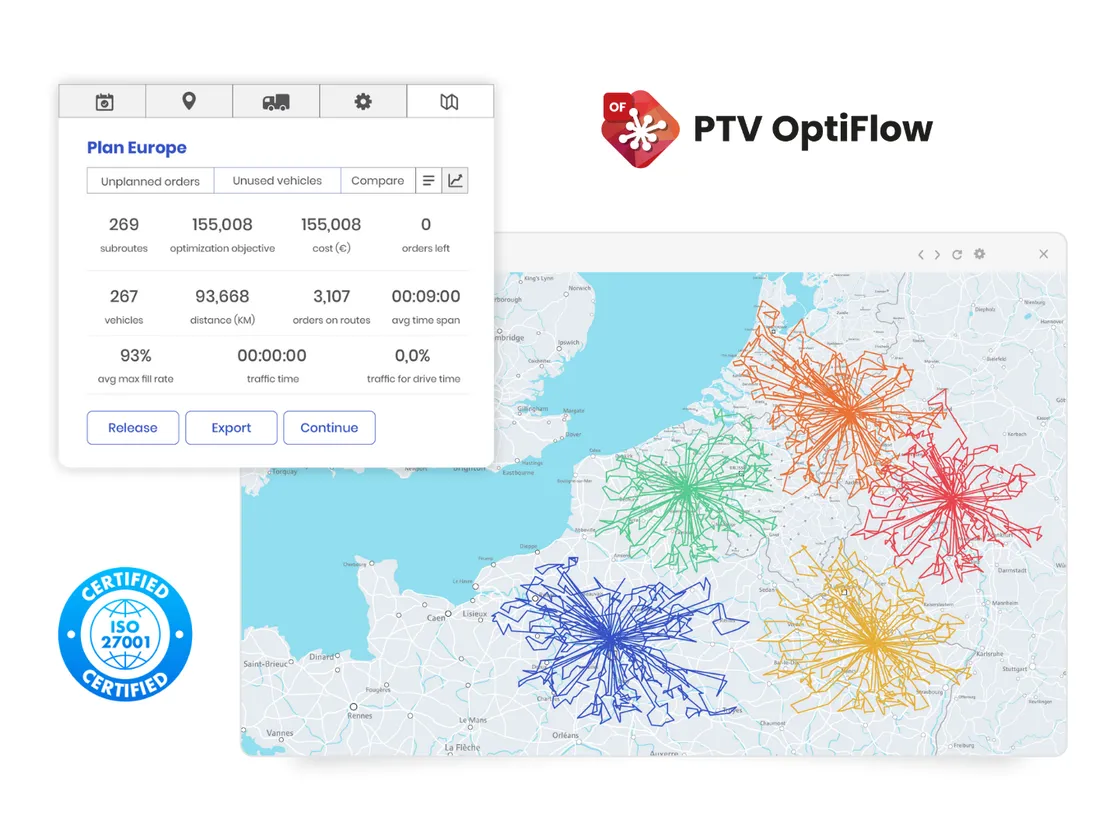
PTV OptiFlow’s strength lies in constraint-aware optimization and vehicle-specific routing. You can’t tackle what you can’t see. It gives you visibility over your constraints, whether they are geographic, technical, regulatory, or operational.
Step 3 – Run scenarios instead of making one “big bet”
In the CEP network optimization world, guessing can be expensive. Instead, use scenario planning for delivery networks to compare “what-if” setups side-by-side before committing capital.
- “What if we open a new depot in a neighboring market?”
(This mirrors the type of decision Rosedor Penja addressed using PTV OptiFlow to refine their depot network, support commercial expansion, and reduce operating costs.)
- “What if we extend the cut-off by one hour?”
(This is the level of operational agility Urbify gained by using PTV Logistics’ optimization and planning capabilities to support late cut-offs and reliable next-day delivery.)
- “What if we move 20% of our volume to subcontractors?”
(GoLilla used PTV OptiFlow to scale from 150,000 to a planned 660,000 deliveries, maintaining a 97.2% on-time rate by expanding their delivery network externally.)
PTV Logistics’s scenario simulation and network design features let planners compare scenarios side-by-side, allowing them to visualize the impact on cost, time, and other resources before they implement any changes.
While PTV OptiFlow executes the optimization and scenario calculations at scale, PTV Mira helps planners interpret the results by comparing alternatives and explaining trade-offs across cost, service, and CO₂ impact. For organizations that need these capabilities embedded into their own systems, PTV Developer provides the optimization logic via APIs.
Step 4 – Integrate decisions into daily planning and execution
Strategic decisions are useless if they don’t reach your drivers. Your network decisions must flow directly into:
- Daily Route Planning: Automated multi-depot route optimization.
- Driver Assignment: Seamlessly pushing routes to telematics for CEP.
- Real-Time Visibility: Using tools like PTV Axylog to bridge the gap between the office and the road
Integrated decisions need integrated tools. PTV Developer provides high‑performance optimization and routing capabilities via APIs, allowing organizations to embed planning logic directly into their own TMS, WMS, order management systems, or custom applications. This enables fully automated workflows, real-time decision-making, and optimization that runs exactly where and how the business needs it.

Step 5 – Continuously refine based on actual performance data
You’re not done yet. Use historical data, such as failed deliveries, recurring bottlenecks, and actual versus planned delays, to sharpen your strategy, continuously tweaking and refining it based on real-life feedback. Update your last-mile network optimization zones based on shifting demand density and refine your courier and parcel fleet optimization by identifying which vehicle types are most efficient for specific postcodes.
PTV OptiFlow supports your feedback loop with high-volume planning scalability, transforming your data into a competitive advantage.
Read more: Enhanced prediction of planned arrival times based on historical traffic information in PTV OptiFlow
How an optimization-first platform supports CEP planner workflows
Advanced smart network optimization is only effective if it empowers the person behind the screen. PTV Logistics is built around planner workflows in last-mile logistics, turning complex data into actionable decisions.
Planner workflows, not just algorithms
A typical day for a CEP planner using optimization should follow a streamlined path. Your chosen platform will analyze demand data, creating forecasts before running scenario planning for your delivery networks so you know what needs to happen tomorrow, next week, and in the long term. Then comes the human element. Planners should approve and adjust suggested plans through simple, visual workflows.
With PTV Mira, planners don’t need to dig through dashboards or exports — they can ask questions in plain language and immediately understand the operational and strategic impact of their decisions.
While there is often a perception gap suggesting parcel delivery route planning software is difficult to use, in reality, modern platforms possess intuitive interfaces, guided workflows, and clear KPIs, not complex raw numbers.
From pilot to scaled value in mid-market CEP operations
You don’t need a global footprint to benefit from CEP network optimization. Many regional carriers and mid-market players follow a phased approach to minimize risk and maximize time-to-value:
- The pilot: Start small; perhaps with just one specific region or a single service line
- Integration: Connect your tools, such as your TMS and telematics, to create a real-time feedback loop between the office and the road.
- Scale: Expand your operations as maturity grows, embracing implementation accelerators, like standard integrations & APIs, and road-tested planning templates.
A checklist of decisions to revisit with smart network optimization
With the logistics landscape continuing to evolve, the tools and techniques that CEP planners need to employ are similarly in flux. Follow this checklist to stay on top of them:
- Are our depots serving the right areas?
- Is our line-haul structure optimal for today’s service promises?
- Can we really deliver on our cut-off times, or are we overpromising?
- Is our fleet mix and subcontractor strategy optimized for cost-to-serve?
- Are we prepared, modelled, and ready for peak seasons?
In the logistics sector, success is increasingly defined by the tools you use. Modern challenges, from sustainability mandates to driver regulations, mean that today, Excel is not enough for route planning.
PTV Logistics is an optimization-first partner for CEP planners. With PTV OptiFlow as the optimization backbone, PTV Mira as the decision intelligence layer, and PTV Developer for seamless integration and customization, Courier, Express and Parcel organizations can move beyond static planning toward truly smart network optimization where territories, sectors, and routes continuously adapt to reality.