

As Courier, Express and Parcel (CEP) networks become more complex – driven by same-day demands and hyper-local fulfillment – rigid rules no longer produce efficient, reliable strategies, leaving planners struggling. Many legacy systems still rely on static routing logic that was never designed for smart network optimization where routing, sectorization, territory planning, and depot allocation must continuously adapt to shifting volumes and service promises.
For high-volume carriers seeking alternatives to rule-based routing, the need for an optimization-first platform becomes clearer every day. Truly dynamic routing for CEP operations requires a solution that plans, optimizes, and executes logistics strategies, not one that simply adds another routing rule layer.
For CEP planners, this challenge spans multiple decision layers: operational decisions like daily route construction, tactical decisions such as sectorization and territory balancing, and strategic decisions around depot locations, service levels, and cost-to-serve. Rule-based routing struggles precisely because it treats all of these as fixed assumptions rather than decisions that need to be optimized together.
Why Rule-Based Routing Is Reaching Its Limits in CEP
Traditional rule-based routing can be overly rigid, with every new operational variable requiring a manual workaround, severely limiting CEP route optimization. With the global CEP market projected to reach nearly $3 trillion by 2033, manually crafting and patching rules is becoming unrealistic. As carriers seek alternatives to rule-based routing, the shift toward optimization-based routing for parcel delivery becomes essential for CEP operations at scale.
How Rule-Based Routing Works Today in Parcel Operations
Rule-based routing functions as a series of static ‘if-then’ directives such as assigning postcode ranges to fixed depots, drivers, or territories that prioritize simplicity over adaptability. This typically results in hard-coded sectorization and territory boundaries that cannot respond to daily volume shifts, changing service levels, or evolving network structures.
In simpler logistics environments, rule-based routing was effective because stable volumes involving fixed territories were sufficient. These legacy systems successfully managed predictable demand through static rules, but they didn’t match up to the constraint-based routing software needed to handle the modern shift toward high-velocity CEP route optimization.
The Operational Symptoms When Rules Can’t Keep Up
The limitations of rule-based routing can leave planners and dispatchers facing a rising number of manual burdens, including frequent route edits. Compensating for the limitations of rule-based routing, they are forced to manage overloaded or underused vehicles, routes that ignore real-life road constraints and traffic, dissatisfied drivers dealing with unbalanced workloads, and deliveries that turn up late despite supposedly optimized routes.
In this environment, last-mile delivery route planning software that lacks true optimization causes a ramping up of time pressure in morning planning windows and increased stress on planners. Frustration rises for drivers and customers.
Strategic Limitations of Rule-Based Routing in Modern CEP
A recent McKinsey survey of logistics leaders found that more than a third now have as many as eight or nine different technology solutions in their transportation tech stacks. Unfortunately, this technology rush isn’t always delivering the optimization expected.
Instead of resolving routing bottlenecks, software adopting a rule-based approach struggles to incorporate the complexities of modern logistics, including new services like same-day, evening, and weekend delivery, dynamic shifts in volume, and business expansions to integrate new depots or cross-border flows. Most critically, rule-based routing provides no reliable way to run what-if scenarios, evaluate strategic trade-offs, or redesign territories and depot responsibilities as the network evolves.
From Rules to Optimization: What Comes Next?
While rule-based routing may be too static for modern logistics demands, true optimization-based routing for parcel delivery looks at the bigger picture.
Optimization-Based Routing vs Rule-Based Routing – Key Differences
Rule-based routing relies on local decisions driven by static conditions, such as assigning a parcel to a driver simply because it falls within a specific postcode. On the other hand, optimization-based routing is a holistic, algorithmic approach that seeks the best solution while considering all constraints. It evaluates millions of permutations while continuing to respect your business rules. Crucially, it doesn’t require planners to maintain long rule lists. This includes optimizing sectorization, territory design, and depot allocation—not as fixed inputs, but as variables within the same optimization model.
For a closer look at how sectorization adapts dynamically as demand shifts, see our guide to route optimization software in 2026.
Constraint-Aware Routing Built for Courier, Express and Parcel Realities
Genuine CEP route optimization takes into consideration time windows (for both B2C & B2B sectors), vehicle capacity (volume, weight, parcel number), driver shift restrictions (maximum driving time and necessary breaks), depot capacity and cut-off times, and stipulated service levels (for both economy and express deliveries).
Platforms like PTV OptiFlow are constraint-aware by design, serving as the optimization backbone that plans routes, sectors, and territories around a network’s non-negotiable operational limits.
Vehicle and Network Specificity – Beyond Generic Navigation
Effective alternatives to rule-based routing focus on vehicle-specific accuracy that accounts for the unique profiles of modern fleets – even if they consist of heavy-duty trucks or e-vans. PTV OptiFlow provides this through road-centric data, ensuring that every stop is planned, with traffic patterns and the physical and legal constraints of the specific vehicle in mind.
As networks become more data‑rich and constraints more detailed, many CEP teams also ask how techniques like AI can support optimization without sacrificing transparency, control, or planner trust.
Read more about it here: Leveraging AI for Route Optimization – An interview with An de Wispelaere
The Main Alternatives to Rule-Based Routing for CEP
Finding alternatives to rule-based routing doesn’t mean committing to a one-size-fits-all migration. Here are a few options planners should consider:
Option 1 – “Patch and Extend” Your Rule-Based Setup
Pros:
- Low change management
- Uses familiar systems
Cons:
- Increasing complexity and fragility of rules
- Still no true global optimization
- Limited scenario planning and network design
Option 2 – Use Simple SaaS Routing Tools on Top of Existing Systems
Pros:
- Speed to value
- Intuitive, clean UI
Cons:
- May not scale for CEP volumes
- Siloed multi-depot and network-wide routing
- Limited APIs or integration challenges
Option 3 – Move to an Optimization-First Platform Like PTV OptiFlow
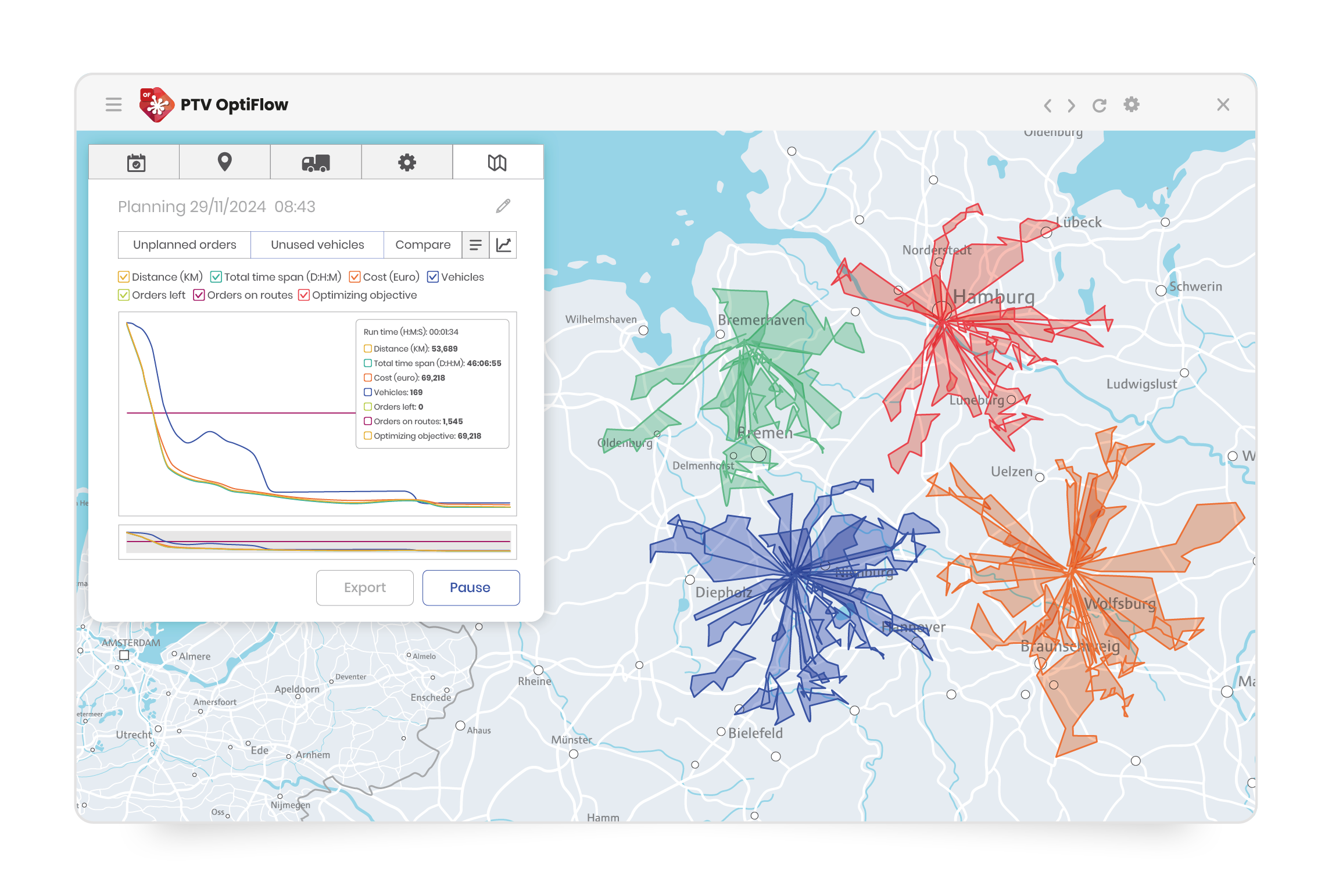
An optimization-first platform treats routing, sectorization, territory design, and depot allocation as part of a single, connected planning problem. PTV OptiFlow supports this approach by enabling operational, tactical, and strategic planning within one optimization engine, allowing CEP planners to move from reactive fixes to scalable decision-making.
Pros:
- High-volume planning scalability
- Multi-depot & multi-leg planning
- Scenario simulation & network design
- Strong integrations & APIs with CEP core systems, such as TMS, WMS, and telematics
- Forge a direct path from planning to execution
Curious how this plays out decision by decision? Here’s a closer look at the depot, line-haul, and service-level choices CEP planners are weighing right now.
When Should CEP Operators Move Beyond Rule-Based Routing?
Deciding when to transition from legacy approaches to optimization-based routing is crucial. For most CEP operators, the shift isn’t triggered by a single event, but by a series of operational warning signs:
Day-to-Day Complexity Signals
The most immediate signs that you have outgrown the limitations of rule-based routing appear in the morning dispatch window. You know you’ve outgrown rule-based routing when:
- Morning planning windows are too tight to fix routes manually
- You’re constantly patching rules after exceptions
- Service quality is inconsistent across days or depots
- You can’t reliably meet delivery time windows during periods of peak demand
Network and Growth Signals
As your business evolves, your routing approach must evolve with it. The move toward CEP route optimization becomes essential as your network design changes, including:
- Expansion to new regions/depots, micro-hubs, lockers, PUDO points
- Introduction of new service levels (same-day, premium slots)
- Transition to mixed fleets (EVs, bikes, subcontractors)
Changes shouldn’t be pursued blindly. Scenario simulations can inform CEP planners of the likely impact of how developments will affect their network design capabilities.
Data and System Readiness Signals
Only when your technical and cultural foundations are in place are you ready to implement alternatives to rule-based routing. Be sure:
- Core operational data exists (orders, stops, depots, vehicle master data)
- You have a plan in place, involving integrations & APIs between TMS/OMS and your routing engine
- There is planning leadership willing to move from “rule maintenance” to “strategy and scenario-based planning.”
Research from Gartner indicates that less than 25% of supply chain organizations have a cohesive internal and external integration strategy in place. If you’re in this position, make sure your technological strategy and leadership values are aligned and consider whether it’s time to shore up your supply chain by embracing alternatives to rule-based routing.
From Maintaining Rules to Managing Scenarios
Instead of simply manually editing postcodes or tweaking rigid rule lists, planners now focus on adjusting high-level constraints and business strategies. Transitioning toward alternatives to rule-based routing allows logistics providers to spend less time on rote data entry and more time on logistics scalability. The planner’s new role involves:
- Adjusting constraints and strategy rather than editing rules
- Running daily plans plus scenario runs (e.g. “What if we shift 10% of volume to Depot B?”)
By automating the menial work of route construction, optimization solutions empower planners to focus on exceptions and strategic improvements, ensuring routes remain resilient even in the most volatile conditions.
To support this shift, decision intelligence tools like PTV Mira help planners explore what-if scenarios, understand trade-offs, and explain optimization outcomes to stakeholders – without replacing the underlying optimization engine. This makes strategic and tactical decisions transparent and defensible.
A Typical Day in CEP Planning with an Optimization Engine
In an optimization-first environment, operational execution is supported by tactical and strategic context. Daily routing becomes faster and more reliable because territories, sectors, and depot responsibilities are already optimized upstream.
A planner’s five-step strategy involving a CEP route optimization solution could look like:
- Import orders and constraints (automatically via integrations)
- Run optimization for all depots and tours in one go
- Review suggested routes, adjusting for local knowledge
- Confirm and release routes to execution (drivers, apps, TMS)
- Monitor execution and react to disruptions via real-time visibility.
By shifting to this workflow, modern logistics providers are likely to see a drastic reduction in manual edits – lowering time and stress.
Handling Exceptions and Real-Time Changes
In a rule-based system, a last-minute change can be hugely disruptive. Optimization-based routing, on the other hand, is more flexible, adjusting in real-time as changes emerge.
An optimization-first platform can manage last-minute orders, cancellations, and failed deliveries, as well as unexpected traffic or road closures. With PTV OptiFlow’s re-optimization capabilities and PTV Axylog‘s real-time visibility, high-volume route planning for parcel carriers can adapt quickly to changes — big or small, sudden or planned.
How PTV Logistics Supports Courier, Express and Parcel Operators Moving Beyond Rules
For high-volume logistics providers, breaking down silos is key — treating the entire operational footprint as a single, synchronized network rather than a collection of independent depots. That means planning across multiple depots and territories at once, balancing fleets between them, and handling high stop volumes without the plan falling apart under pressure.
Multi-Depot, High-Volume CEP Optimization
PTV OptiFlow is built for exactly this: it plans routes, sectors, and territories across a multi-depot network in a single run. In practice, that’s looked like centralizing planning across seven depots, running more than 400 routes and 5,000 to 6,000 stops a day — proof that multi-depot planning holds up at real CEP volumes.
Scenario Simulation and Network Design for CEP
Testing a plan before committing to it shouldn’t mean guesswork. PTV OptiFlow’s optimization engine runs the underlying route, sector, and territory calculations, while PTV Mira adds a decision-intelligence layer on top – turning what used to take hours or days of manual scenario testing into something explored in minutes, without replacing the optimization engine itself. Together, this helps planners:
- Simulate new depot openings or closures
- Model changes in service promises or time windows
- Analyze cost-to-serve by region or customer segment
Fast Time-to-Value with Strong Integrations and APIs
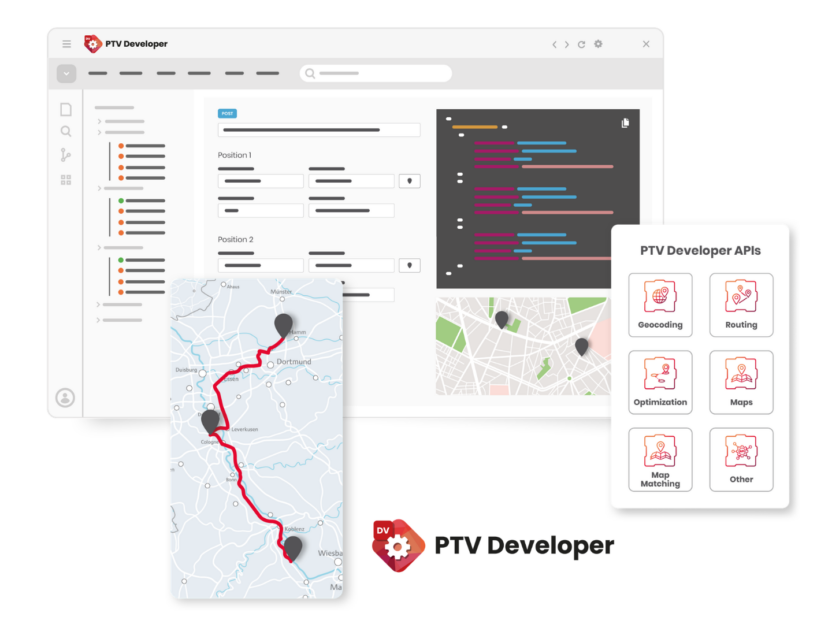
Optimization doesn’t have to mean a multi-quarter rollout. Integration with TMS, OMS, telematics, and CEP core systems can start small – a single region or depot – and scale from there. For organizations embedding optimization into existing TMS, WMS, or custom workflows, PTV Developer provides the APIs and extensibility layer to do that without disrupting core systems.
Just because optimization may be advanced doesn’t mean it should be difficult to adopt.
Measurable Outcomes: From Cost to Service Quality
Moving from a manual, rule-based approach to optimization-based routing changes what you measure. In practice, that tends to look like:
- More stops per route/per vehicle
- 23% shorter driving distances
- Up to 97%+ on-time delivery rates
- Route plans built in as little as 20–30 minutes
How to Evaluate Alternatives to Rule-Based Routing
Choosing the right alternatives to rule-based routing requires looking past marketing slogans and drilling down into core capabilities. To ensure your chosen solutions can handle modern delivery demands, CEP leaders should challenge vendors with the following key questions:
Key Questions to Ask Vendors
- How do you handle multi-depot, multi-leg CEP networks?
- What constraints can your route optimizer model out of the box?
- How many stops/routes can you plan in a single run?
- How do you support planners’ daily workflows?
- What is the typical time-to-value and integration pattern?
And don’t just take the vendor’s word for it. Ask to see proof of value. Demand validation of any answer the vendor gives and compare promises against the historic data produced by your legacy systems.
Fit Checklist for CEP Operations
Use the following checklist to identify if your current complexity necessitates a move to optimization-based routing for parcel delivery:
- Volume thresholds
- Number of depots and regions
- Required service levels and time windows
- Fleet composition and partners (subcontractors)
- Need for network design and scenario planning.
Steps to Pilot Optimization-First Routing with PTV Logistics
Don’t make the mistake of thinking that moving to an optimization-first approach means immediately throwing out all your current routing tools and starting all over again. In fact, most successful CEP operators follow a structured, low-risk pilot program to prove the value of optimization-based routing before a full-scale rollout:
- Start with a subset of depots or regions
- Compare optimization-based plans vs current rule-based plans
- Measure clear KPIs (cost, time, on-time rate, planner effort).
Faced with fragmented planning across seven depots, ID Logistics transitioned from manual, rule-based logic to an optimization-first strategy with PTV Logistics. By centralizing their distribution network, they replaced planner demands with a scalable, automated engine. The results were immediate: evening planning time was slashed by two hours, and the team size required for dispatch dropped from five planners to just two. Managing 6,000 daily stops became a streamlined process rather than a manual burden.
Making the move
The era of rule-based routing is at an end. With many delivery networks expanding and growing in complexity, the limitations of static rules have become a bottleneck to growth.
As CEP networks scale in volume and complexity, static rule-based routing becomes a constraint rather than a safeguard. Optimization-first approaches allow planners to manage operational execution while continuously improving territories, sectors, and network design – turning complexity into a controllable planning advantage.