
Key takeaways
- Retail delivery scheduling coordinates B2B store replenishment and B2C last-mile delivery under tightening time windows — over 78% of online consumers now expect delivery within two hours of ordering, according to Industry Research.
- Six core constraints shape every retail route: store time windows, truck attributes and legal routing rules, loading/handling requirements, multi-depot and multi-region complexity, tightening urban access rules (e.g. Madrid’s ZBE, Paris’s traffic-calming zones), and seasonal spikes — DHL alone handles 14+ million shipments on its busiest Black Friday day.
- Constraints aren’t barriers, they’re catalysts: treating driver break times, vehicle limits, and time-window promises as inputs to the plan — rather than exceptions to route around — is what separates advanced retail scheduling from basic point-to-point routing.
- Scheduling runs in six steps: forecasting demand and delivery frequency, planning routes against time windows and constraints, assigning the right vehicle to each load, sequencing stops for efficiency, running what-if scenario simulations, and monitoring execution in real time.
- The industry is shifting from single-route thinking to network-level thinking: the strongest retail networks now treat network design, day-to-day route optimization, and adaptive service-area sectorization as three connected layers, not three separate projects.
- Scenario simulation pays off: McKinsey found digital twins can improve consumer-promise fulfillment by up to 20%, cut labor costs by 10%, and lift revenue by 5%.
- Reliability is now a commercial risk, not just an ops metric: on-time delivery across Europe’s e-commerce and logistics sector hit a record 98.5% in Q3 2025, while 84% of consumers won’t return to a retailer after one poor delivery experience.
- The retailers pulling ahead treat scheduling as continuous, not fixed — combining constraint-aware and multi-depot optimization to lower costs while raising service quality.
What is retail delivery scheduling?
Retail delivery scheduling is the strategic process of coordinating the movement of goods across the entire retail value chain – encompassing both store replenishment (B2B) to maintain shelf availability and outbound distribution (B2C) to meet last-mile consumer demands. At its core, this function relies on retail logistics planning to synchronize vehicle availability, labor shifts, and inventory levels against a backdrop of increasingly narrow delivery time window constraints.
Expectations are high in the retail space. Emphasizing how customer tolerance for delay is at rock bottom, Industry Research reports that over 78% of online consumers now expect deliveries within two hours of a purchase being made. While other verticals might prioritize cost-per-pallet or bulk efficiency, retail is uniquely time-sensitive for several reasons, including the perishability of certain goods, tighter margins, and strict urban regulations.
In retail logistics, the planner isn’t just someone who moves inventory around; they manage the friction between marketing, the on-road reality, and store capacity. They have to oversee multi-layered constraints (at the store, driver, and vehicle levels), respond dynamically to live disruptions, and orchestrate differing (sometimes conflicting) stakeholder demands.
The core constraints that shape retail delivery scheduling
In retail, a route isn’t simply a path between two points, but a delicate negotiation between physical reality and legal necessity. Failing to account for a single constraint doesn’t just cause a delay – it can result in substantial fines, blocked city streets, or empty stores. Here are some of the most common constraints planners face:
1. Time-window restrictions imposed by stores
A grocery store in a high-traffic area may require all heavy replenishment to be completed between 4:00 AM and 6:00 AM, for example. Missing this window by 15 minutes means the truck remains at the loading dock when the first customers arrive, creating a safety hazard and blocking the Click & Collect lanes. This is why truck routing with time windows built in is so important.
2. Truck attributes and legal routing rules
Effective route optimization for retail must account for the physical profile of all the vehicles within a fleet. Unlike standard couriers, retail often utilizes a mix of HGVs and light vans. For instance, a delivery to a flagship city-center store might require a rear-steer truck to navigate tight corners, or a vehicle with a specific tail-lift height to match an aging loading bay. It’s about aligning the vehicle with the drop.
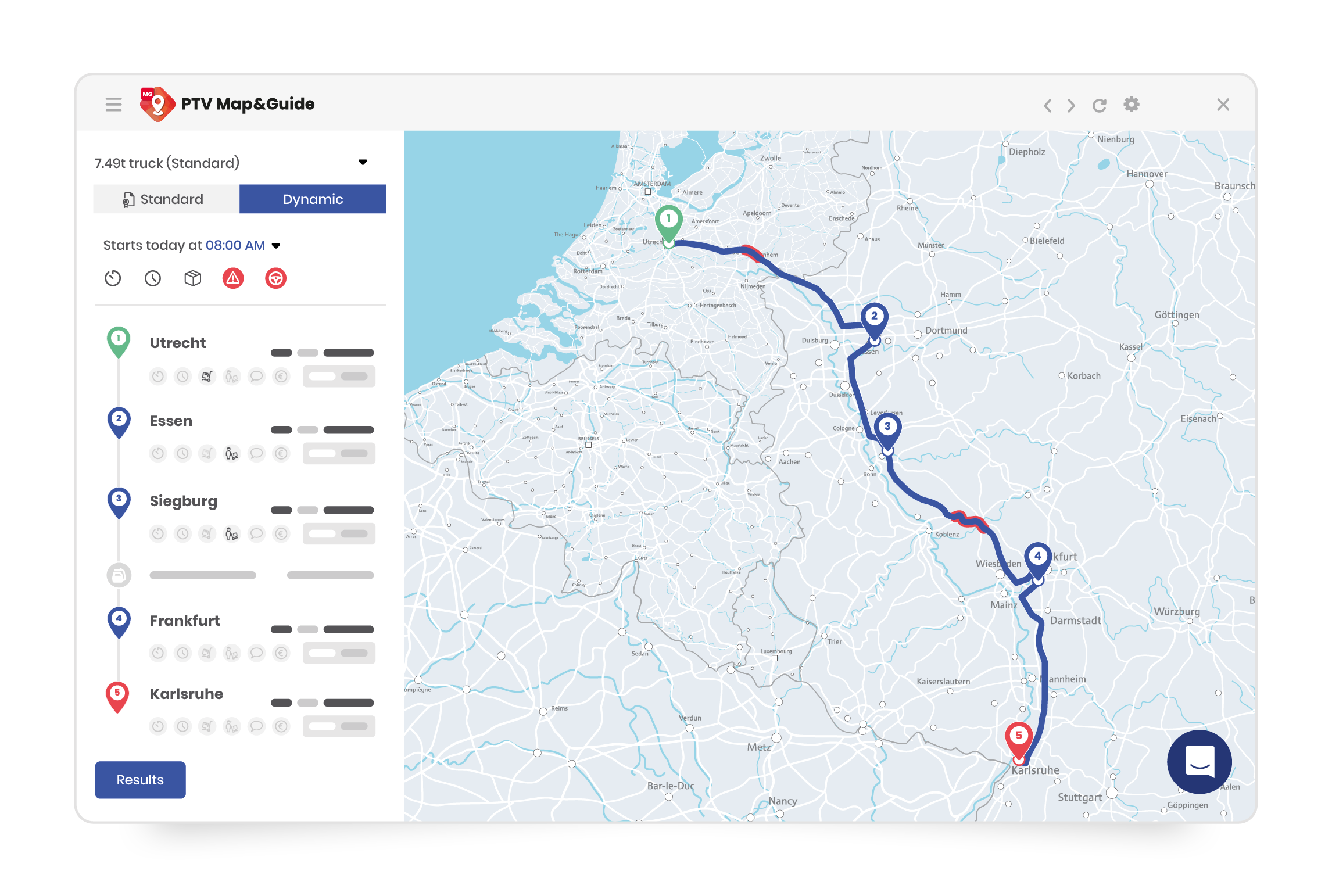
Getting this right at the planning stage before a truck is even dispatched, is what determines whether a delivery is even attempted. Truck route planning software such as PTV Map&Guide works through these vehicle-specific restrictions in advance, matching height, width, and axle-load profiles to what each store can actually receive.
3. Loading/handling constraints and cut-off times
Retail logistics planning must factor in how goods are handled – not just the route they take. Whether roll cages or pallets are being used will have a major impact on unloading times and equipment needs, so must be factored in for each drop.
4. Multi-depot and multi-region complexities
Large retailers rarely ship from a single point. The challenge is balancing inventory across a multi-depot retail distribution network. Coordinating overlapping flows, whether delivering cargo to an end-user or bulk replenishing store inventory, requires high-level delivery scheduling optimization.
We go deeper into how retailers balance depot assignments and fleet capacity across a multi-depot distribution network without adding trucks here.
5. Urban access restrictions for retail-heavy cities
Retail-heavy cities are tightening the rules around emissions and congestion. Madrid recently made its Zona de Bajas Emisiones (ZBE) rules tougher, limiting which vehicles can enter which parts of the city based on their emission standards. Paris has done something similar with its traffic-calming zones. Failure to synchronize route optimization for retail with these live city protocols may not just mean a late delivery – it could lead to a total loss of access.
6. Seasonal or promotional demand spikes
In retail, there is no average delivery volume. During Black Friday, for example, volume can surge. As a case in point, DHL has confirmed that it will handle more than 14 million shipments on its busiest day, 60% more than the average. One constraint here is loading dock throughput. Even if you have the trucks, you might only have a limited number of loading bays. As such, scheduling must be staggered perfectly to ensure that as soon as one truck pulls out, the next is ready to reverse in, maintaining a continuous flow of goods.
How delivery scheduling works in practice
In a modern retail environment, scheduling is a continuous cycle of refinement. A professional retail logistics planning workflow balances long-term strategy with the on-road reality.
Step 1: Forecasting demand and delivery frequency
Before trucks are assigned to specific deliveries, route planning tools analyze order volumes. For store replenishment, this means looking at sales velocity to decide if a convenience store needs a daily drop or less-frequent bulk delivery.
From the planner’s viewpoint, an understanding of volume outliers remains paramount. For example, if a promotion has recently launched, they’ll be aware of the need to increase frequency there, even if the historical data doesn’t show it yet.
As order patterns shift by region or season, the zones and frequencies planners set at the outset need to keep pace too: a theme covered in our guide to route optimization software in 2026, including how smart sectorization keeps delivery zones aligned with real demand rather than last year’s map.
Step 2: Planning routes considering time windows & constraints
This is where delivery scheduling optimization is key. Digital tools automatically cross-reference every order against core constraints, like mall access slots, store opening times, and driver hours. At this stage, the software does a lot of the work, flagging impossible routes immediately, so the planner can focus on the exceptions.
Step 4: Sequencing deliveries for efficiency
At this stage, the goal is to minimize idle time. Sequencing ensures that drivers aren’t criss-crossing paths but moving in a logical, efficient loop that maximizes drops per hour. Planners monitor the drop density, so if a sequence looks scattered, two smaller routes could potentially be combined into one larger, more efficient run to save on fuel and driver overtime.
Step 5: Scenario simulation for peaks, disruptions, or network changes
Before the fleet leaves the depot, planners run what-if simulations, including: What happens if a major highway is closed? What if order volume spikes by 20% for a flash sale? This allows them to stress-test different scenarios so they’re prepared for every eventuality. McKinsey reports that the use of supply chain digital twins – key to modern scenario simulations – typically result in as much as a 20 percent improvement in fulfilling consumer promises, a 10 percent reduction in labor costs, and a 5 percent revenue uplift.
Scenario simulation like this is built into tools such as PTV OptiFlow, letting planners test the impact of a network change or a demand spike against their own data before committing to it.
Step 6: Execution & real-time visibility
Once the drivers are on the road, the static plan becomes a dynamic route. Using route optimization for retail tools, the system monitors live traffic and vehicle positions. Planners make use of re-optimization tools to shift deliveries, if necessary, to ensure customers are satisfied and SLAs are met.
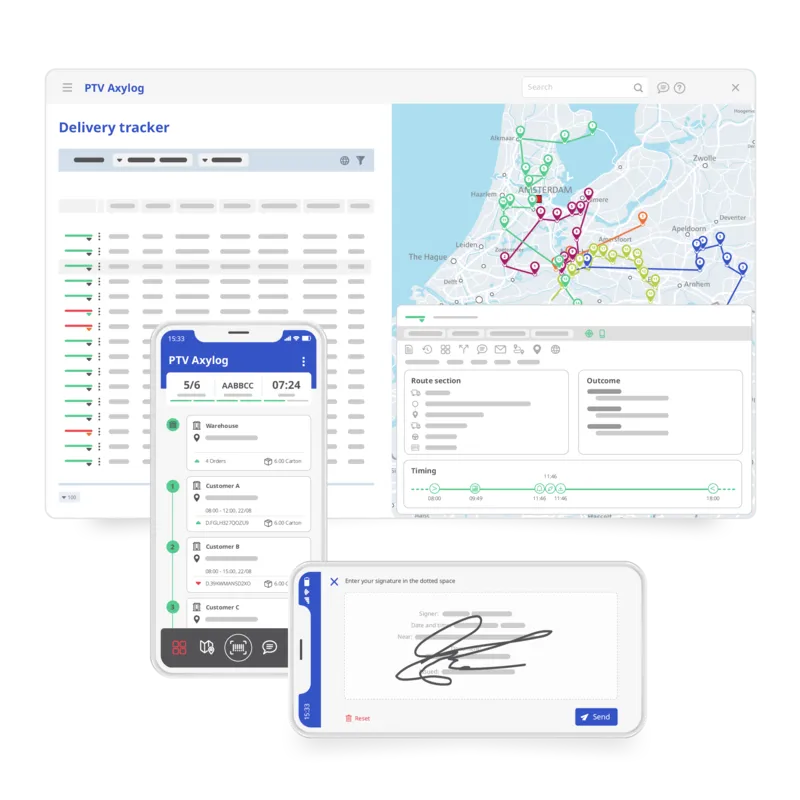
Platforms such as PTV Axylog give planners this live view – tracking ETAs, flagging exceptions, and capturing proof of delivery as the day unfolds so that re-optimization decisions are based on what’s actually happening on the road, not the morning’s plan.
Route optimization strategies used by advanced retail operations
Moving beyond basic point-to-point routing requires a shift toward holistic network intelligence. Advanced retail operations don’t just look for the shortest path; they look for the most profitable, sustainable, and reliable routes across their entire footprint.
Constraint-aware routing and scheduling
While basic tools treat every stop the same, advanced retail delivery scheduling sees constraints as guideposts that inform your plan. From driver break times to vehicle height limits and strict time-window promises, constraints aren’t barriers; they’re catalysts – opportunities for greater route optimization.
Multi-depot planning to balance regional load
Although legacy systems often plan each warehouse or distribution center separately, smart systems view the entire region as a single, holistic network. Multi-depot optimization allows for greater regional load balancing and reduces the need for expensive third-party spot-hire vehicles during volume spikes.
Load & capacity optimization
Advanced retail logistics planning considers the physical dimensions and handling requirements of the cargo before the truck is loaded. Modern retail fleet planning systems ensure roll cages and pallets are sequenced in the right order, maximizing the fill rate of every trailer, while taking weight limits into account. This means retailers can often reduce their total fleet requirement.
Integrating ETA visibility to refine delivery promises
Even the best schedule will benefit from a real-time feedback loop, so when the actual delivery time deviates from the planned one, the system automatically updates the relevant ETAs. Operationally, this means store managers can reschedule their shelf-stocking team based on a more precise arrival window, reducing labor idle time. Expectations are high, with on-time delivery rates across Europe’s e-commerce and logistics ecosystem recently hitting a record 98.5% – visibility and feedback are key to hitting this figure or even exceeding it.
Using network design to optimize store delivery cycles
Strategic route optimization for retail isn’t just a daily task; it’s a long-term network design strategy. For instance, by analyzing historical data, retailers can identify which stores would benefit from shifting to a new delivery cycle. By combining the stability of a fixed-route plan with dynamic flexibility, the last mile can be consistently optimized.
We explored this shift toward network-level thinking with Thomas Greiter, Chief Commercial Officer at PTV Logistics, in From Indecision to Impact: Why Retail & Last-Mile Leaders Choose PTV Logistics.
Technology enablers
In today’s retail landscape, general-purpose tools are no longer sufficient to manage modern last-mile complexities. PTV Logistics provides a specialized ecosystem designed to turn the complexity of retail scheduling into a scalable, automated competitive advantage
- Truck-specific routing for retail fleets: Retail delivery often involves navigating tight urban corridors with vehicles of varying sizes. PTV Map&Guide and PTV OptiFlow utilize professional truck maps that factor in physical restrictions, environmental regulations, and safety concerns.
- Multi-depot route optimization: Large retailers don’t ship from a single point but manage overlapping regional flows. PTV OptiFlow acts as a unified brain for multi-depot planning, balancing live capacity and vehicle availability.
- High-volume planning for large store networks: Retailers managing thousands of deliveries a day need speed at scale and depth of insight from their tools. Algorithms must be optimized to handle 10,000+ stops in minutes and complex variables have to be factored in simultaneously.
- Scenario simulation for seasonal campaigns: In retail, delivery volumes are rarely consistent year-round. With the right tools, however, planners can build digital twins of their network to test what-if scenarios, so they can predict what will happen, for example, if they change their delivery cycle for Black Friday or are exploring how many extra third-party vehicles they’ll need if order volume spikes by a certain amount.
- Integration-friendly APIs for order, TMS, WMS: For those who prefer to build routing and optimization directly into the order management, WMS, TMS, or ERP system they already run, PTV Developer offers 17 individual APIs, covering route optimization, truck routing, geocoding, and mapping that can be mixed and matched into an existing tech stack rather than replacing it. As digitalization ramps up, this is what lets retail logistics planners pull a single, holistic picture of their operations out of systems that would otherwise stay separate.
- Road-centric visibility: A plan is only valuable if it’s executed. PTV Axylog provides real-time oversight for your entire retail journey, providing live ETA tracking, electronic proof of delivery (ePoD), and exception management.
- Ease-of-use & fast time-to-value: The greatest hurdle to technology adoption is often a fear of complexity. PTV solutions focus on fast time-to-value, so any perception gap regarding a tool’s learning curve is immediately addressed. With an intuitive interface and a cloud-first approach, retailers can get optimized routes up and running in no time.
Example use cases in retail
The true power of an optimized scheduling engine is best seen in how it handles the unique, high-pressure environments of different retail sub-sectors. Here is how advanced technology solves specific vertical challenges:
Grocery delivery scheduling with tight windows
Managing perishable goods, high-volume home deliveries, and store replenishment is a race against the clock. But speed isn’t the only important factor. With grocery now a dominant e-commerce category, success actually depends on delivery precision over speed. Research shows 60% of consumers now value a reliable, promised time slot more than ultra-fast delivery.
Fashion store replenishment with mall access constraints
Fashion logistics requires planners to balance high-velocity seasonal launches with the strict access windows of many flagship stores. This is where constraint-aware scheduling becomes crucial, ensuring fashion trucks are routed based on specific mall access rules.
Home & DIY chains with mixed truck profiles
Many of the items shipped by home improvement retailers, such as timber and appliances, are heavy and bulky, meaning they cannot be moved in a standard van. Load-specific optimization matches the truck profile to the handling unit. With fleet utilization key to DIY margins, inadvertently scheduling a truck for a store that isn’t equipped to receive it means a missed delivery and a costly rescheduling.
High-frequency LTL store delivery networks
Less-Than-Truckload (LTL) networks play an important role in regional retail, moving frequent, mid-sized shipments to hundreds of suburban locations – but it requires managing multi-depot coordination at scale. PTV Logistics’ tools can provide the oversight to deliver this coordination, balancing regional deliveries across multiple distribution centers to maximize drop density.
KPIs improved by better retail delivery scheduling
The best delivery scheduling tools don’t just tell you that the performance of your operation is improving; they prove it. They do this by measuring some of the key metrics underpinning your routes. They take the guesswork out of planning by focusing on the following KPIs:
| KPI | Impact of Optimized Scheduling |
|---|---|
| On-Time Delivery Rate | The stakes are high here, with recent research showing that 84% of consumers will not return to shop with an online store following just one poor delivery experience. As such, reliability is critical. Optimized scheduling helps ensure promises are met by factoring in live traffic and store-specific access windows before the truck sets off. |
| Cost-to-Serve per Store | This metric tracks the total logistics spend required to keep a single location stocked. Advanced optimization helps lower this by consolidating orders and maximizing drops per route. |
| Fleet Utilization | Are your trucks running full, or are you sending more than you need to because of less-than-optimal fill rates? Better scheduling aligns order volume with the specific capacity of your fleet. Advanced solutions can help, too. This has been demonstrated through statistics showing that AI-driven routing can boost average fleet utilization rates to anywhere between 85 and 95%. |
| Mileage Reduction | Every kilometer driven unnecessarily represents more financial outgoings and higher carbon emissions. Optimization solutions sequence stops to create the tightest possible loops, eliminating being on the road when you don’t have to be. Research consistently shows that optimized routing consistently delivers 20% to 40% reductions in total mileage. |
| Planning Time & Planner Productivity | Logistics workers can spend more than 50% of their time on manual tasks – whether that’s data entry or managing deliveries. However, with tools like PTV Logistics, thousands of routes and constraints can be calculated in seconds rather than hours. This allows planners to transition from admin to adding value. |
| Exception Rate Reduction | Exceptions, such as missed windows, blocked loading bays, or shipments becoming lost, are the primary cause of margin erosion. By using digital twins to simulate scenarios and real-time visibility to manage disruptions, retailers can identify and resolve these exceptions before they damage their bottom line. |
Becoming a future-proof retailer
As consumer expectations for precise and sustainable delivery become the standard, the difference between market leaders and those struggling to catch up lies in their scheduling maturity. By moving away from manual spreadsheets and adopting a constraint-aware, multi-depot optimization strategy, retailers can finally solve the paradox of logistics: lowering costs while increasing service quality.