

Key Takeaways
- Route optimization improves day-to-day transportation execution by determining the most efficient routes, schedules, vehicle assignments, and delivery sequences.
- Network optimization improves the logistics structure itself by evaluating depot locations, service territories, transport flows, fleet allocation, and long-term operating models.
- Route optimization is primarily tactical, helping planners reduce mileage, improve vehicle utilization, and meet service commitments.
- Network optimization is primarily strategic, helping organizations balance cost, service, capacity, sustainability, and future growth.
- The strongest logistics operations use both, combining an optimized network design with optimized daily route execution.
Logistics leaders are continually looking for ways to improve efficiency while also lowering costs and avoiding operational risks. That is why many consider the pros and cons of route optimization vs network optimization.
Route optimization helps you run today’s operation better. Logistics network optimization helps you decide what the operation should look like in the first place. One is mainly tactical. The other is mainly strategic. In practice, the strongest results come when both work together.
In this article, we explore how route optimization solutions fit into that bigger picture, where network optimization plays a different but closely related role. First, we define what each approach actually does. Then we look at the questions each one helps answer, the problems each one solves best, and how to decide which should come first in your operation.
Why compare route optimization vs network optimization?
Transport leaders face rising costs, labor shortages, stricter urban and emissions-related constraints, tougher SLA expectations, and more volatility in daily order volumes. That pressure makes it difficult to evaluate which software tools can deliver the most value for your business. Teams hear terms like route planning, route optimization, logistics optimization software, transportation network design, and scenario planning in logistics network design, but they are often trying to answer a simpler question: what problem are we actually trying to fix first?
The clearest way to understand the difference is:
- Route optimization focuses on the routes you need to run today, tomorrow, or this week.
- Network optimization focuses on the structure those routes run on over the next quarter, year, or expansion cycle.
If your planners are struggling with daily execution, route optimization may add the most value. If your depot footprint, service areas, or fleet mix are driving structurally poor results, when to use network optimization becomes the more important question
Definitions: What is route optimization vs what is network optimization?
What is route optimization?
In plain terms, it is the process of building the best possible daily plan for a set of orders, vehicles, drivers, and constraints. That means deciding which vehicle should serve which orders, in what sequence, at what time, on which roads, and under which operating rules.
Good route optimization software respects time windows, vehicle capacities, loading and unloading times, legal restrictions, driver hours, road restrictions, tolls, and truck attributes such as height, weight, refrigeration needs, or hazardous goods requirements. It accounts for the specific constraints that matter to your operations, including prohibitions, schedules, times, real vehicle restrictions, and multi-depot scenarios.
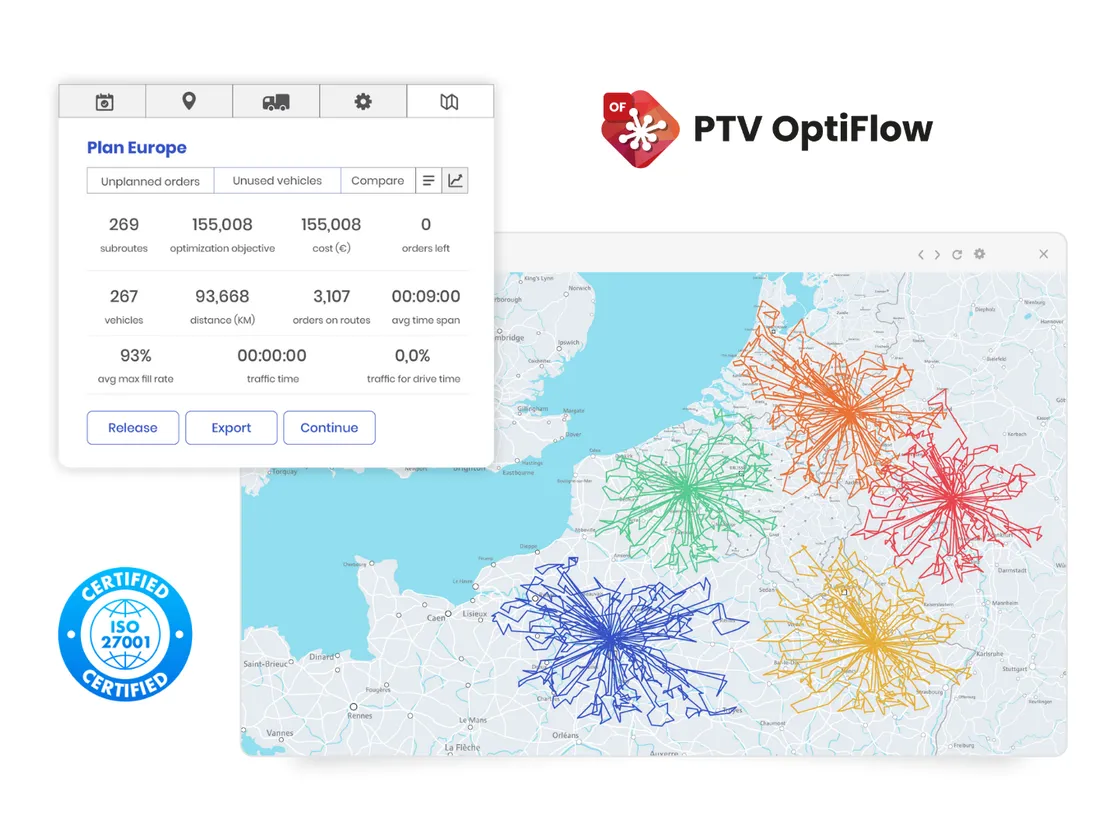
If you are managing a complex logistics network, you will benefit most from a route optimization solution that offers multi-depot route optimization, multi-leg planning, cross-depot assignment logic, and dynamic re-optimization for up-to-the-minute changes. The SaaS version of PTV OptiFlow, for example, can optimize up to 15,000 orders in a single plan and supports cross-site planning and re-optimization as conditions change. With APIs from PTV Developer, you can manage over 50,000 orders per run.
Estimate the business impact of route optimization
Route optimization balances complex variables such as time windows, vehicle capacities, road restrictions, driver availability, and multi-depot operations. Our savings calculator helps you estimate the potential cost savings, efficiency gains, and ROI opportunities based on your own logistics setup.

What is logistics network optimization?
Logistics network optimization is the process of designing the operating structure that your transport plan runs on. That includes questions such as:
- Where should depots or distribution centers be located?
- Which customers should each site serve?
- How should territories be defined?
- What fleet mix do you need by region?
- Which flows should run direct, through cross-docks, or through linehaul and last-mile combinations?
- How do cost-to-serve, service targets, emissions targets, and growth scenarios change those decisions?
This is where transportation network design and freight network design and simulation come in. Instead of focusing on exact daily stop sequences, they use broader operational data to shape a more effective logistics structure. The goal is to define the right depot setup, service areas, and transport flows so daily routing can perform better within that framework.
This is also where scenario planning in logistics network design matters. PTV Logistics supports this, for example, with capabilities such as depot and territory modeling, multi-scenario investment analysis, fleet and electrification planning, and comparisons between different depot location options.
Key differences: Time horizon, questions, data, and decisions
Time horizon and questions they answer
A key difference between route planning vs network planning is the time horizon.
Route optimization answers questions like:
- How do we serve today’s orders with today’s fleet?
- How do we hit delivery windows with fewer miles and less overtime?
- How do we absorb late orders or disruption without breaking service?
Network optimization answers questions like:
- What should our depot footprint look like next year?
- How should we redesign territories as volume shifts?
- Which operating model gives us the best balance of cost, service, and sustainability?
You can think of it as the difference between strategic vs tactical logistics planning. Route optimization improves execution inside the current structure. Network optimization improves the structure itself.
Data, constraints, and outputs
Route optimization requires detailed operational data: orders, customer locations, time windows, service times, vehicle types, driver availability, road network data, truck restrictions, and current depot assignments.
Network optimization usually works with broader operational data: demand by region, service-level targets, transport costs, facility capacities, candidate depot locations, stem distance assumptions, fleet mix, and territory logic.
The outputs are different too.
Route optimization produces daily plans, route sequences, ETAs, workload allocation, and vehicle usage. Network optimization produces recommended depot locations, territory definitions, lane structures, facility roles, fleet balancing and territory optimization logic, and modeled cost-to-serve changes across scenarios.
How network decisions shape routing outcomes
It is important not to underestimate how network-related decisions impact your routing. For example, if your depot footprint is wrong, even the best route optimization software will keep generating expensive plans.
A structurally weak network creates long stem distances, overloaded sites, underused vehicles, awkward service boundaries, and recurring exceptions in remote areas. Daily routing can only optimize within those limits.
That is why logistics cost-to-serve optimization often has to move up a level. Sometimes the answer is not trying to create better routes from the same depots. It could instead mean different depot-customer assignments, different territory boundaries, or a different linehaul and local delivery split.
When to prioritize route optimization
Signs you need better route optimization methods
Route optimization should usually come first if your main challenges are related to daily planning and execution. That is often the case if your planners are still routing in spreadsheets, generic maps, or basic TMS modules. It is also clear when simple route planning tools are not enough because the operation has outgrown basic sequencing and needs real constraint handling.
Typical signs include:
- Planners spending hours each day on manual route building
- Frequent missed time windows
- Regular driver overtime
- Poor handling of order spikes and late changes
- Manual depot assignment in a multi-site operation
- Weak truck-specific accuracy in urban or regulated areas
If you are facing challenges like these, transport planning software for complex operations can create fast value for your organization by reducing planning time, improving route quality, and making plans easier to adjust.
What good route optimization looks like
Good route optimization is constraint-aware, truck-specific, scalable, and usable. It should account for driver hours, capacities, legal restrictions, loading and unloading times, customer windows, and the actual roads the vehicle can legally and practically use. It should also support multi-depot route optimization and work across high stop counts without forcing planners into constant manual repair work. Lastly, it needs to fit real workflows. Planners should be able to change business rules, rerun plans quickly, and make guided adjustments without losing control of the operation.
PTV OptiFlow is designed for high-volume route optimization at scale, helping logistics teams plan efficiently across complex transport operations. For organizations looking to embed routing capabilities into their own systems, PTV Developer offers APIs that support heavy-vehicle routing, precise ETAs, urban delivery scenarios, and multi-depot operations.
Impact on planner productivity and time-to-value
Many logistics-driven organizations prioritize route optimization because it is known to quickly deliver operational benefits. When planners spend less time building and adjusting routes by hand, teams can improve consistency, reduce daily pressure, and create a stronger basis for further improvement.
For example, when foodbox delivery organization HelloFresh implemented PTV OptiFlow for route optimization, planners were able to work independently after one or two days, while transportation costs fell by 7% immediately and 16% over four years, and delivery accuracy reached 93% within 30 minutes of the scheduled time. Transport firm ID Logistics centralized its planning across a seven-site network using PTV OptiFlow, which reduced the number of evening planners from five to two, cut planning time by 1.5 to 2 hours per day, and lowered kilometers by up to 4%.
In both cases, planning became easier to manage day to day, which also put the logistics teams in a better position to look at broader network design optimization.
Read more about it here: HelloFresh reduces costs and CO₂ with PTV OptiFlow
When to prioritize network optimization
Signs your network design is the real constraint
When to use network optimization becomes clear when the daily route problem keeps coming back no matter how hard planners work.
Typical signals include:
- long empty approaches before the first stop
- recurring territory overlap
- depots that are consistently overloaded while others sit underused
- frequent exception routes to serve fringe regions
- continual discussions about opening, closing, or repurposing facilities
In situations like this, the challenges extend beyond route optimization and instead requires systemic improvements. The question then becomes how to make the changes you need while keeping operational disruption to a minimum.
What good network optimization and design looks like
The most effective and least disruptive way to optimize your network is to simulate realistic scenarios before making expensive decisions.
That includes testing scenarios like these:
- depot openings and closures
- changes in service areas
- volume shifts by region
- alternative fleet mixes
- service-level changes
With optimization software that supports scenario testing, you can also show logistics cost-to-serve optimization clearly enough to address concerns from all stakeholders, including finance, operations, and logistics leadership.
Network optimization for CEP, retail, and logistics providers
Network and route optimization for CEP / parcel carriers often centers on depot balancing, linehaul versus last-mile structure, and peak-volume scenarios. In retail and e-commerce, the focus is more likely to be store delivery territories, regional DC roles, cross-docking choices, and how to protect service windows while controlling stem distance.
For 3PLs and transport providers, network optimization helps model operating options for new contracts, support tenders, and show clients how service and cost change under different network assumptions.
How route and network optimization work together and when you need both
Tactical vs strategic: A layered optimization approach
The strongest logistics strategies treat route optimization and network optimization tools as layers that support each other. Network optimization helps define the right operating structure by deciding things like depot roles, service areas, and customer assignments. Route optimization then uses that structure to build better daily plans based on actual orders, vehicles, time windows, and operational constraints.
Together, they create a more reliable basis for decision-making. You can test a network change such as shifting customers between depots or redefining territories, then assess how that change would affect route length, workload balance, service levels, and vehicle use in day-to-day operations.
3 practical steps for mid-market and complex operations
Most mid-sized organizations operating a complex logistics network see quick benefits when they optimize route and network design in these three steps:
- Replace manual or limited tools with route optimization software that can handle real constraints.
- Once your routing process is more stable, use the resulting data and performance patterns to identify structural network issues.
- Move into an iterative model where network design decisions and daily routing performance inform each other.
This gradual approach lowers risks and costs, because you do not have to redesign your entire logistics strategy or software stack all at once. Start with one related set of routes, one region, or one pain point, then work your way up towards broader logistics optimization software capabilities over time.
How PTV Logistics supports both route and network optimization
From planning and optimization to execution visibility
Once route optimization and network optimization work together, the next question is how to support that in practice. For many logistics teams, that means connecting better planning decisions with the systems and workflows already in place.
PTV Logistics supports that across several levels of the operation. For daily planning, PTV OptiFlow helps teams manage high-volume, constraint-aware, multi-depot planning and re-optimization. For companies that want to build optimization into existing platforms and workflows, PTV Developer provides APIs for routing, geocoding, ETA calculation, restrictions, cost logic, and custom logistics processes. Once plans move into execution, PTV Axylog adds real-time transport visibility, proof of delivery, slot booking, anomaly workflows, and transport control tower capabilities.
For longer-term planning, PTV Mira supports logistics network design by helping organizations evaluate depot locations, territory structures, fleet requirements, electrification strategies, and alternative network scenarios. Combined with capabilities such as multi-scenario analysis and network-based sectorization, this helps connect long-term design choices with the realities of day-to-day transport planning and execution.
Fast time-to-value and fit for mid-market and complex operations
For many businesses, the main concern is how difficult optimization will be to introduce. Success stories like HelloFresh and ID Logistics show what that can look like. In both cases, route optimization delivered clear operational gains in a relatively short time, including faster planner onboarding, lower transport costs, less planning effort, and fewer kilometers. That gives teams a practical starting point. They can improve one part of the operation first, then build on that foundation as planning needs become more complex.
This is especially relevant for mid-market companies and growing logistics networks. You can start where the pressure is highest, connect optimization to the systems you already use, and expand into broader network design or scenario analysis as the business case becomes clearer.
How to decide your next step: Quick checklist
Are you still unsure whether your organization should prioritize route optimization or network optimization? A practical way to decide is to review two things at the same time: route-level performance and overall network health. Look at planning time, service performance, route quality, and overtime. Then compare those findings with broader indicators such as stem distance, depot load balance, cost by region, and how often planners have to compensate manually for structural weaknesses in the network. The following quick checklist can also help get you started:
Use route optimization if:
- your main issues sit in daily planning and execution
- planners spend too much time building routes manually
- missed time windows, overtime, or last-minute changes disrupt daily operations
- you need better control over constraints such as vehicle types, driver hours, and delivery windows
Use network optimization if:
- you are questioning your depot footprint or service areas
- some depots are overloaded while others are underused
- long stem distances or recurring exception routes drive unnecessary cost
- you need to compare structural options such as opening, closing, or repurposing sites
Plan for both if:
- you are expanding into new regions
- you are managing multiple depots with overlapping territories
- you are changing service promises or delivery models
- the same route problems keep returning even after improving daily planning
Your answers to this quick scan will help you identify where the biggest opportunities for your logistics operation are. Once you know that, you can see which kind of optimization will create the most value now, and what should come next.