

Told separately, these sound like two unrelated news items: one about vehicles, one about software. Told together, they turn out to be the same story: planning is shifting from reacting to deciding, and the industry rewards whoever recognizes that shift first.
The timing isn’t abstract. 2025 already showed clear signs of strain across European road transport, with insolvencies rising, including among long-established operators. The sector is short an estimated 500,000 professional drivers across Europe. (Source: European Commission / IRU, “Bus and truck drivers from third countries”, February 2026)
Neither AI nor electrification fixes these pressures on its own but both are how the industry is already responding to them, which is exactly why the strategic-timing argument matters now rather than later.
The four-stage shift: React, Predict, Recommend, Decide
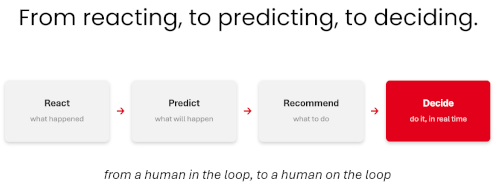
At PTV Logistics Days 2026, Jan Rzehak, COO of PTV Logistics, described the way planning systems are evolving as a shift through four stages.
First, systems told planners what had happened: react.
Then they started telling planners what was likely to happen next: predict.
More recently, they began suggesting what to do about it: recommend.
Now, for the first time, some systems can decide and act on their own, in real time, with a person supervising the outcome rather than approving every step.
Rzehak’s framing of what separates companies that benefit from this shift from those that don’t is blunt: it isn’t about which tool you buy, it’s about whether you orchestrate what you already have. Getting your team licenses and calling it an “AI strategy” changes very little.
“What matters is bringing people on board, identifying real use cases, and building quick wins before you orchestrate and doing it on clean data and processes.”
— Jan Rzehak, COO, PTV Logistics
AI can work with incomplete data. Inconsistent data is what breaks it.
The same shift, applied to electric fleets.
Map those four stages onto a heavy-duty EV fleet and the pattern repeats almost exactly.
A few years ago, fleet software could only tell a planner what a route had cost, after the fact: react.
Then came tools that could estimate how much range a route would consume: predict.
More recently, planning systems started suggesting where and when to charge: recommend.
Today, the most advanced route planners for electric commercial vehicles can calculate charging stops automatically, in real time, based on remaining range, mission schedule, and live station availability – decide, with the planner supervising rather than clicking through each leg of the journey.
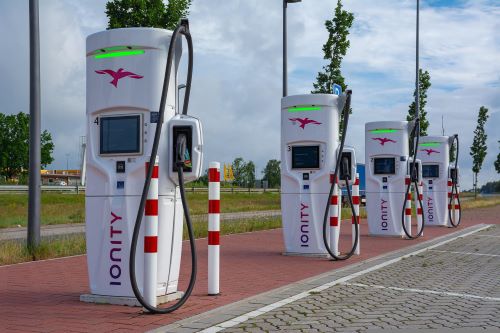
This matters because it reframes what “switching to electric” actually requires. According to Michael Hubschneider, Senior Product Manager for the PTV EV Truck Route Planner at PTV Logistics, the most common mistake fleets make is treating an electric truck as a diesel truck with a battery, optimizing for range and charging without rethinking the operation itself. A diesel truck might run for 8 hours and park. An electric one, with a well-timed charge, can potentially run for 12 or more, if the planning system is built to recognize that opportunity rather than replicate the old duty cycle. That’s not a detail about vehicles. It’s the same shift from reacting to deciding, playing out one route at a time.
For a deeper look at the operational challenges and opportunities of fleet electrification, read the interview with one of our leading experts in this field, Michael Hubschneider, here.
Why fragmentation is the real obstacle, not the technology.
In both AI and EV adoption, the barrier that slows companies down is rarely the individual tool. It’s fragmentation. A route planner that doesn’t talk to a charging-network map creates exactly the same kind of friction as an AI tool bolted onto a workflow nobody redesigned around it: both leave a person doing the orchestration work by hand, defeating the purpose of the technology in the first place.
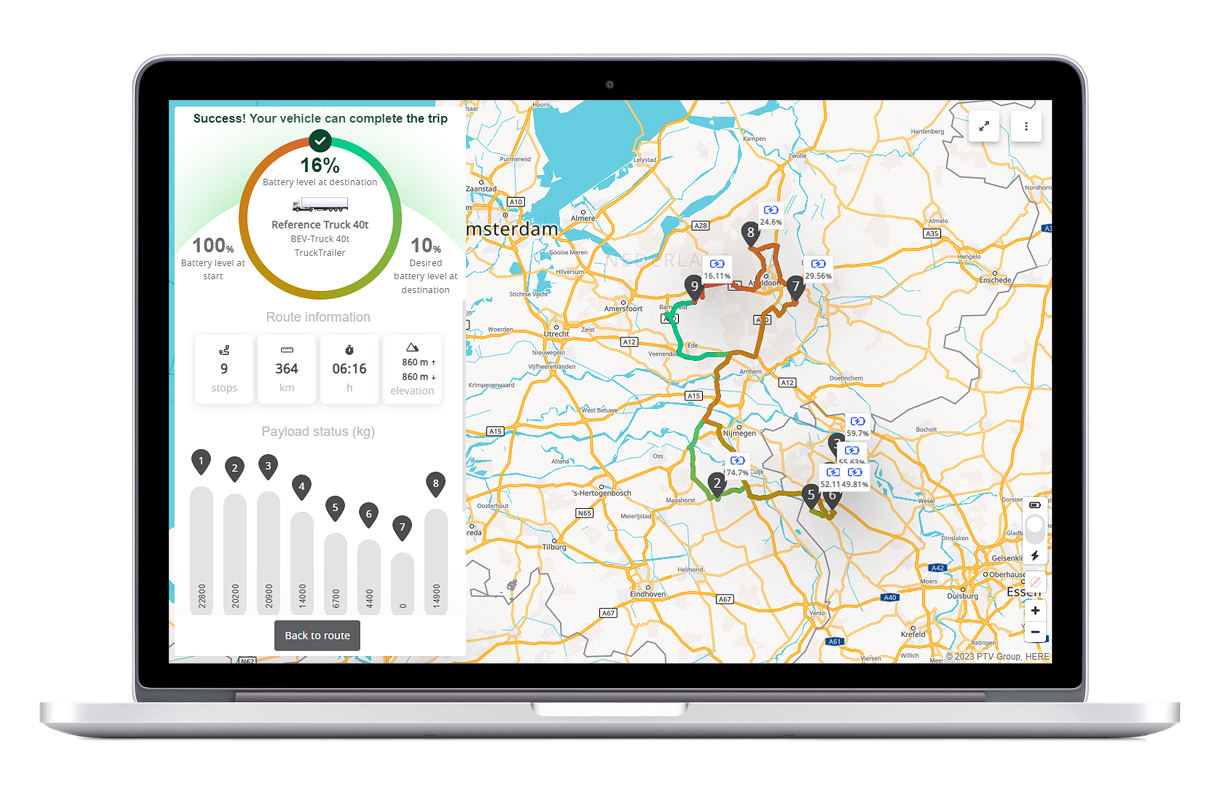
A recent, concrete example of closing that gap: FLEET220, a ROUTE220 company and certified B Corp, has built PTV Logistics’ EV Truck Route Planner into myevTruck, its own platform for managing electric commercial fleets. The result is that route planning and charging-stop planning, previously two separate steps handled with two separate tools, now function as a single decision inside one interface. It’s a useful illustration of what orchestration looks like in practice: one example among others likely to follow, as more companies with complementary capabilities choose to connect their tools rather than compete on owning every piece themselves.
At a European scale, the pressure to solve this kind of fragmentation is only growing. Amazon’s delivery network alone now runs more than 10,000 electric delivery vans across Europe, together with its partners. Multimodal, mixed fleets (diesel, electric, hybrid, in some cases cargo bikes) are no longer an ideological choice; cities are making them a requirement. Software that can’t hold battery range, charging availability, and access restrictions together, in real time, becomes the bottleneck, regardless of how good any single tool in the stack might be.
Turning strategy into action
If fleet electrification is part of your roadmap, our Fleet Electrification Guide explores the planning considerations behind a successful transition—from route assessment and charging requirements to operational deployment.

Leadership, not procurement: the strategic window
“Organizations that learn to embed this new strategic mindset into decision-making over the coming years will be better positioned to outperform their markets and shape the future of logistics.”
— Jan Rzehak, COO, PTV Logistics
Rzehak said this about AI. Read it again with fleet electrification in mind, and it holds just as well. Neither shift is a purchasing decision. Buying an electric truck, or an AI licence, changes almost nothing by itself. Deciding how to reorganize planning around what they make possible is what actually moves the needle — which routes to electrify first, which tools need to share data with each other, which parts of the planner’s job move from clicking to supervising.
That’s also why this isn’t primarily a budget question. The companies pulling ahead in both transitions tend not to be the ones spending the most, but the ones who started early, on real routes and real problems, and let the operational evidence shape the next decision. The direction, across Europe, is no longer in question for either shift. What’s still being decided, company by company, is who moves first.
Explore the PTV EV Truck Route Planner and see how automated, real-time planning works on your own routes.