

When managing highly complex, high-density distribution networks, the difference between an average routing tool and a genuine enterprise logistics platform determines whether you save millions in operational expenditure or are left watching your profit dwindle. For VPs of operations, supply chain directors, and IT procurement teams overseeing fleets of 50 to 500 or more commercial vehicles, route optimization can’t be achieved via a simple point-to-point calculation. It is a highly constrained, multi-layered mathematical and operational challenge.
This objective buyer’s framework provides a structured evaluation guide for organizations auditing and procuring logistics network optimization software. When drafting your next RFP, use these eight core categories to separate superficial dispatch applications from enterprise-grade platforms.
1. How should you evaluate solver quality and constraint handling?
The quality of your solver – the underlying mathematical algorithm that processes your routing data – determines the efficiency of your entire fleet. While basic algorithms rely on simplistic nearest-neighbor sequencing, this breaks down instantly when faced with multi-constraint, high-density environments.
To evaluate vehicle routing solver architecture, procurement teams must assess how software models complex, real-world rules, including:
- Physical fleet & cargo constraints: Physical limits like axle-load capacities, bridge heights, hazardous material restrictions, and complex compartment constraints
- Driver & labor rules: Driver-specific attributes, such as regulatory working-hour limits, union rest-break rules, and specific technician skill sets.
- Complex multi-depot operations: The solver should dynamically optimize pickups at one depot, mid-route drop-offs at another, and cross-docking transitions without manual intervention.
Planners should look for a fully automated, cost-driven routing engine like PTV OptiFlow where you define what cost means for your business (time, distance, capacity, workload) and the solution optimizes against it.
2. How do you test scalability across stops, vehicles, and depots?
The scale at which enterprises operate can mean that even minor database latency may block daily departures. Your chosen software should be able to handle extreme transactional throughput without a decline in performance. When defining your scalability requirements for high-volume multi-depot vehicle routing, look carefully at the computational performance on offer, with larger logistics providers requiring platforms that can process datasets across thousands of stops.
3. What should API and TMS or ERP integration look like?
Logistics software shouldn’t exist in a silo. Legacy systems that rely on batch CSV uploads or rigid, custom-coded point-to-point tools introduce substantial integration challenges and single points of failure. This is a significant enterprise bottleneck, with recent WNS data showing that 89% of operational leaders have failed to see the expected ROI from their supply chain software specifically because of data and integration challenges.
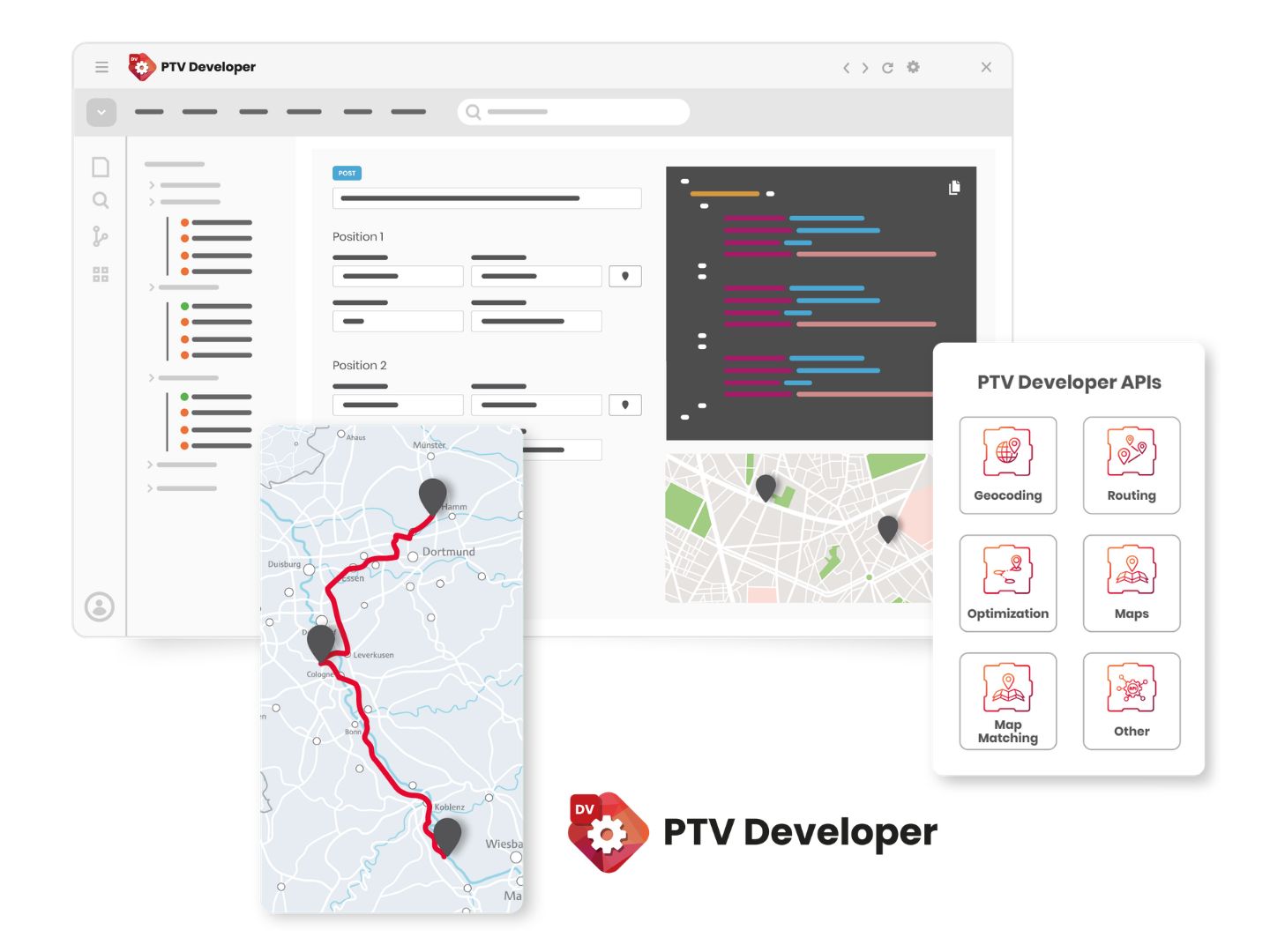
PTV Developer is API first by design. It offers 17 individual APIs covering routing, geocoding, optimization, traffic and mapping that you can combine, and it embeds into your existing TMS, ERP or WMS without forcing a new workflow.
4. How should software replan routes during the day?
It should replan active routes when something changes, such as traffic, a delayed pickup or a new urgent order, and show planners the updated ETAs without restarting the whole plan.
A schedule drafted in the morning starts aging the moment the first vehicle leaves. Put three tests into your RFP: how quickly the tool recalculates ETAs after a delay, whether planners can insert a high priority pickup into an active route, and whether the change leaves untouched routes alone.
5. How much control should planners keep?
While automated optimization handles the bulk of the work, planners require intuitive control layers to manage unexpected, real-world exceptions. When examining different vendor offerings, keep a close eye on planner manual override capabilities. Some common features that reinforce the importance of human planners include drag-and-drop visual map interfaces that allow for manual route recalibration, precise exception management, and conversational simulations. Fleet personnel can make the most of the latter with PTV Mira.
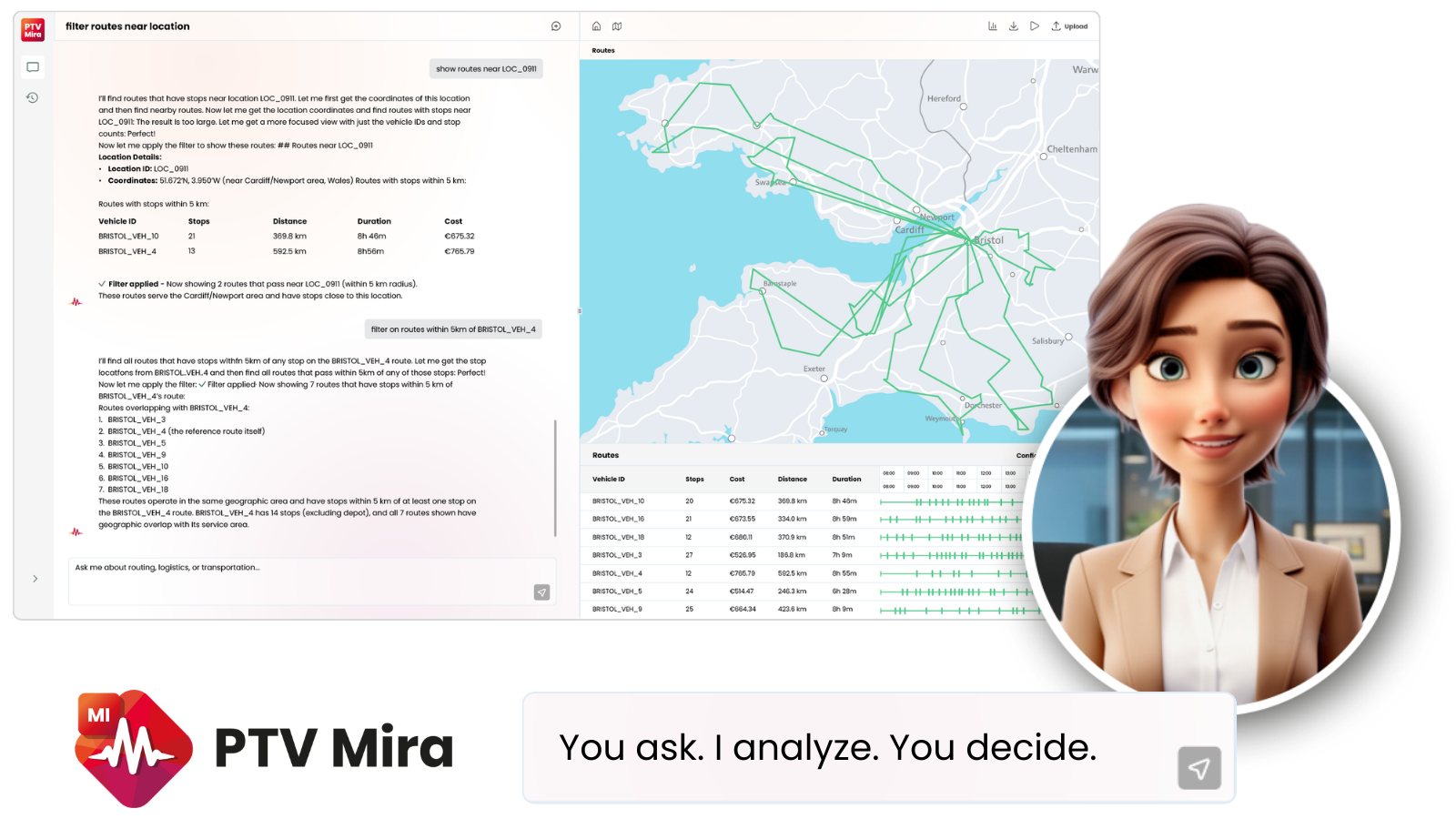
PTV Mira is a conversational AI logistics expert that turns planning questions into real optimizations, compares scenarios and explains the results. PTV Mira Assistant supports planners with daily operational questions, and PTV Mira Consultant supports strategic scenario comparisons. PTV Mira supports the decision, and users approve every action.
6. Which reporting and KPIs should you require?
If you can’t measure something, there’s no way of optimizing it. And the stakes are high. Research by Capgemini shows that the last mile consumes 41% of total logistics supply chain costs, meaning any failure to audit and optimize these metrics could result in more than just lower profits – it may put your entire corporate health at risk.
Collecting data on several metrics, from costs per stop to scope 3 emissions, is crucial for eliminating waste – wasted budget, wasted time, and wasted fuel. This isn’t only important for financial reasons. It is critical for compliance, too, and could even help protect the critical commercial partnerships within the supply chain.
7. What implementation support should you expect?7. Implementation support and onboarding
Expect a named onboarding team, hands on training for planners and dispatchers, clear documentation, and a proof of value on your own data before you commit.
Even a strong solver delivers nothing if planners and drivers do not use it, so adoption support belongs in the scoring. Ask for the rollout plan, who trains your planners, and what a proof of value measures.
Running a smaller fleet? “Is my company too small for a route planning software?” looks at where route planning pays off at that scale.
8. How do you build a total cost of ownership model?
Include license fees and how pricing scales with volume, integration and onboarding effort, ongoing maintenance, and the cost of staying with your current planning process.
A lower upfront fee can hide integration delays and high maintenance fees. Build a three to five year model, and add a line for the status quo: the extra kilometers, overtime and manual planning hours you carry today. Without that line, you cannot see what suboptimal routing costs you. Our savings calculator can help you size it. Try it here.
Turning our structure evaluation into strategic decisions
Score every vendor on the eight criteria using your own data, weight them by what hurts most today, and shortlist only the vendors that pass a proof of value. Test the claims on your own routes, and talk to our team about running your own planning scenarios.