

Standard Transportation Management System (TMS) routing is fine. But is it really good enough?
On the contrary, recent research indicates that over 70% of TMS projects fail to meet their objectives. Standard TMS routing may be necessary, but it is often fundamentally insufficient for modern courier, express, and parcel (CEP) networks that need to balance service promises, peak volumes, and profitability.
While TMS routing is typically designed for basic planning, true CEP optimization requires specialized, constraint-aware, high-volume optimization and scenario simulation. Continue reading to discover how you can deliver all this and more.
CEP Operations Have Outgrown Basic TMS Routing
The logistics landscape has shifted under the weight of explosive parcel volumes and the relentless pressure of same-day and next-day commitments. As consumer expectations skyrocket, many providers find themselves hitting a ceiling because they still rely on TMS routing functions originally designed for simpler, linear freight flows. While TMS routing may be sufficient for high-level oversight, it often lacks the granular agility required for true CEP optimization.
In the world of courier express parcel routing, the variables are far more volatile than those you see with traditional trucking. You aren’t just moving pallets from A to B; you are managing thousands of micro-stops with tight windows. Relying on basic legacy modules often results in a “good enough” plan that fails when faced with the complexity of last mile optimization software needs.
This leads us to a critical realization for the modern carrier: Your TMS is essential for managing orders, shipments, and execution – but its routing module alone cannot optimize a modern CEP network. To achieve genuine parcel delivery route optimization, companies must look beyond standard features toward specialized route optimization for the CEP sector that can handle the density and dynamism of today’s market.
What Standard TMS Routing Actually Does (and Doesn’t)
While a TMS is the foundation of logistics administration, using its basic routing module for a high-velocity parcel network may leave planners lacking the precision and depth required by the complexities of the modern-day last mile.
The Role of a TMS in Logistics Operations
According to Global Market Insights, the TMS market size was valued at $15 billion in 2025, with a CAGR of 10.6% expected through to 2035. It continues to be a hugely valuable piece of supply chain technology, serving as the essential system of record for planners. Its primary mandate is to oversee the lifecycle of a shipment from order inception to financial settlement. For most logistics managers, the TMS is indispensable for:
- Order and Shipment Management
- Rate Shopping and Carrier Selection
- Tendering and Documentation
- Basic Route Building
Despite its utility, it’s crucial to point out that TMS routing is typically rule-based and schedule-based, not deeply optimization-first. As such, it can fall short in the volatile world of courier express parcel routing.
If rule-based logic is already showing its limits in your network, our blog – alternatives to rule-based routing for CEP operations breaks down the options and how optimization-based routing changes route quality, driving distance, and on-time delivery rates.
Typical Limitations of TMS Routing for CEP
Because standard TMS routing was originally designed for simpler freight flows, it may not be suitable for the complexities of modern logistics. The table below outlines why TMS routing can be found lacking:
| Feature | Standard TMS Routing | Optimization-First Route Planning |
|---|---|---|
| Routing Logic | Simplified & Generic: Relies on static routes or simple heuristics that assume “Area A” always follows “Area B.” | Dynamic & Algorithmic: Recalculates the most efficient sequence for every single trip based on real-time data. |
| Stop Density | Low-Density Focus: Struggles to sequence routes efficiently once a driver exceeds 20–30 stops. | High-Density Mastery: Built for the needs of last mile optimization software, handling 150+ stops per vehicle with ease. |
| Constraint Modeling | Basic: Usually limited to “must deliver today” with little regard for narrow time windows or curb-side access. | Granular: Accounts for vehicle restrictions, driver skills, and precise 15-minute delivery windows. |
| Operational Agility | Fixed Schedules: Difficult to adjust once the schedule is printed; poor support for dynamic same-day orders. | Real-Time Injection: Seamlessly integrates on-demand orders into existing routes without disrupting the entire flow. |
| Network Scope | Linear/Single-Depot: Best for moving freight from a warehouse to a single destination. | Complex Networks: Supports multi-depot, multi-leg, and cross-docking flows across a wide courier express parcel routing grid. |
| Strategic Insight | Execution Only: Minimal or no “what-if” scenario simulation for peak seasons or new depot launches. | Strategic Planning: Includes network design capabilities to model the impact of new services or fleet expansions before they go live. |
CEP-Specific Challenges That Break Simple TMS Routing
While a TMS is an excellent administrative tool, the operational reality of a modern parcel network presents challenges that standard rule-based tools simply weren’t built to solve.
Extreme Stop Density and Tight Time Windows
In the CEP world, planners may have to cover 80–150+ stops per day, per vehicle. When you layer on tight, overlapping time windows – such as prioritizing business deliveries in the morning while accounting for residential windows throughout the afternoon – simple TMS logic is unlikely to be enough.
Basic systems often sequence stops based on the as-the-crow-flies distance or static zones, failing to account for the cumulative impact of dozens of micro-delays. This can lead to unrealistic schedules that leave drivers scrambling to meet SLAs.
Same-Day, On-Demand, and Peak Volumes
Peak season can be both a blessing and a curse for logistics firms. While it’s true that demand skyrockets, the extra deliveries can send costs spiralling too. Data from the UK’s 2025 peak season, for example, found that while delivery volume for carriers went up by 11%, costs increased by 28%, demonstrating how demand and the cost of meeting it might not scale linearly.
During peak seasons, the lack of high-velocity last-mile optimization software can become a massive bottleneck. When volumes triple, standard TMS modules can take substantial amounts of time to process a plan. This forces planners to resort to manual alternatives – splitting routes by hand or relying on expensive overtime – because the system can’t replan a huge multi-stop network in the time required to get drivers on the road.
Multi-Depot, Cross-Depot, and Subcontractor Management
Modern CEP networks are no longer linear; they are a web of central hubs, regional depots, and urban micro-satellites. Managing a mix of owned fleets and various subcontractors adds another layer of complexity that standard TMS routing can struggle with.
Most TMS tools assume fixed territory assignments. They lack the flexibility to dynamically reallocate volume between depots or rebalance loads across subcontractors based on real-time capacity. Without specialized CEP optimization, you end up with one depot overwhelmed while another sits underutilized, simply because the software can’t see the network as a fluid, holistic entity.
If this sounds like where your network is headed, single- vs. multi-depot planning: challenges, tradeoffs, and solutions covers that transition in more depth, including the fleet-balancing and depot-assignment problems that tend to surface first.
Real-World Road and Vehicle Constraints
A plan is only as good as its execution. Basic TMS routing frequently ignores vehicle-specific road data, including access restrictions and vehicle attributes. When software ignores these variables, it produces routes that look good on paper, but which are difficult or even impossible for drivers to navigate. Individuals are then forced to fix plans on the fly, deviating from the original sequence and destroying the accuracy of the customer’s ETA. For true route optimization for CEP, the software must understand the road as well as the driver does.
Signs That Your TMS Routing Is Holding CEP Operations Back
For planners and operations leaders, if the morning starts with a frantic race against the clock to manually override your software’s suggestions, it’s a clear sign that your TMS routing has shifted from being an asset to a burden.
Some signs that it may be time to change for a change in your tech stack include:
- Excel addition: Planners constantly export routes to Excel to fix TMS output, representing an unnecessary manual burden
- Driver rebellion: Drivers routinely ignore planned routes because they’re unrealistic. Teams rely on local knowledge rather than route plans, meaning planners lose all visibility into last mile optimization software performance and ETAs.
- Growing delays: Particularly in urban or high-density areas, you may see a growing number of missed time windows and late deliveries. This is a common sign that your parcel delivery route optimization solution cannot handle the complexity of urban constraints.
- A complex tech stack: If you find that you need a broad plethora of tools – one for operational planning, another for ad-hoc re-optimization, and a third for strategic network design, your operations will be fragmented and disconnected, with nothing integrated or consistent.
- Scaling limits: You may have discovered that scaling your parcel volume or adding a new micro-depot requires hiring more dispatchers rather than just pursuing further optimization. If your growth depends on headcount rather than algorithmic efficiency, your courier express parcel routing isn’t scalable.
- Cost clarity: You struggle to accurately calculate the true cost-to-serve for specific customers or routes. When leadership asks where the money is being lost in the network, you can’t give a data-backed answer because your TMS doesn’t provide the granular insights needed for CEP optimization.
Questions to Ask Before Choosing a Route Optimization Platform
If any of the symptoms above sound familiar, use these questions to evaluate whether a platform is genuinely built for CEP route optimization or just a TMS with a different label:
- Can it recalculate full routes in minutes when volumes spike, or does it rely on manual re-planning once things get busy?
- Does it model real-world constraints — vehicle restrictions, driver skills, narrow delivery windows, low-emission zones — natively, or only as manual workarounds?
- Can it plan across multiple depots and reallocate volume dynamically, or is it built around fixed, single-depot territories?
- Does it support “what-if” network design and scenario simulation for peak season or new depot launches, or only day-of execution?
- How does it integrate with your existing TMS, telematics, and driver apps — through documented APIs, or as a standalone silo?
- Is it built for planners to use day to day with a manageable learning curve, or does it require specialist expertise to operate?
Want the longer version? Questions every operations manager should ask before buying route optimization software expands this into a full vendor-evaluation checklist, covering ROI, total cost of ownership, and integration depth beyond these six questions.
What an Optimization-First CEP Planning Approach Looks Like
Transitioning to an optimization-first model isn’t just about replacing a map; it’s about upgrading from a basic calculator to a smart tool designed specifically for the volatility of the modern world of logistics.
Constraint-Aware, High-Volume Route Optimization
True CEP optimization requires software that treats real-world constraints as non-negotiable requirements, not mere suggestions. An optimization-first approach models every variable simultaneously to give you a holistic picture of your journey. PTV OptiFlow, for example, handles this at the network level — planning multi-depot and multi-leg movements in a single run and scaling to thousands of stops and hundreds of routes in minutes. The road-level restrictions that a standard TMS tends to ignore — legal and physical constraints like low-emission zones and bridge heights are exactly what PTV Map&Guide is built to account for during planning.
Network Design and Scenario Simulation as a CEP Superpower
There is a significant difference between daily operational planning and long-term strategic planning. While your TMS might describe the here and now well enough, a true optimization-first platform allows you to inhabit various “what if” scenarios. This is a critical PTV Logistics differentiator – the ability to perform strategic network design and scenario simulation.
Using cloud-based route optimization tools, like PTV Optiflow, planners can run data-backed simulations to answer questions like:
- “What if we open a new depot here?”
- “What if we move this postal code range from Depot A to Depot B?”
- “What if we promise same-day delivery in this region?”
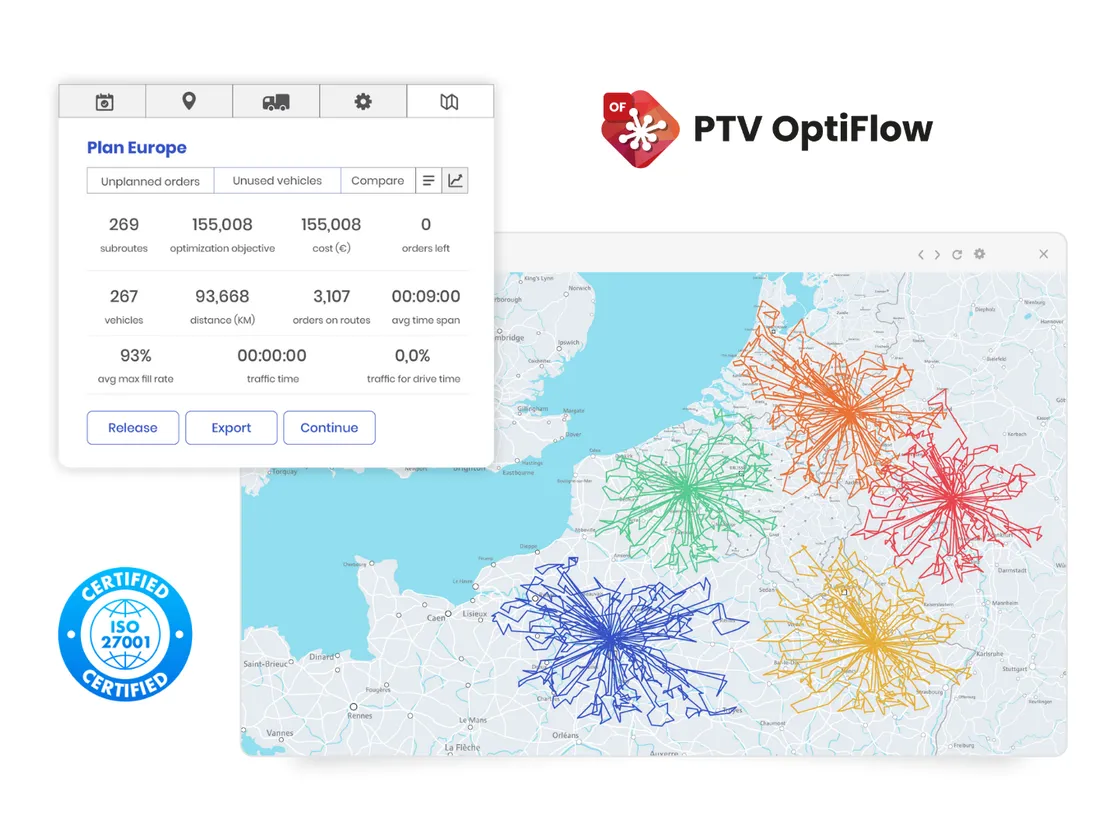
For planners who need an answer even faster, PTV Mira, for example, is an interactive logistics intelligence agent that lets teams ask a network question in plain language such as which depot is closest to capacity and get an operational answer back immediately, without waiting on a full simulation cycle.
The simulations available to planners turn route optimization for CEP from a reactive chore into a proactive competitive advantage, allowing them to stress-test their network before peak season hits.
Planner-Friendly Workflows, Not Black-Box Tools
According to a recent McKinsey survey, over 40% of companies in the logistics space admit that past digital implementations have taken longer or much longer than expected to achieve their business goals. Don’t let this gap – whether it’s due to a steep learning curve or prolonged time-to-value – hold back your CEP optimization.
High-performance last mile optimization software should reduce manual effort, not add another tool for employees to fight with. The right platform should fit seamlessly into existing workflows.
How a TMS and an Optimization Platform Work Together in CEP
Don’t throw out your TMS just yet. By decoupling execution from planning, your TMS and a true route optimization solution can complement each other, creating a strategy that is fit for the modern CEP sector.
TMS as the System of Record, Optimization as the Brain for Planning
Integration can link your TMS and route optimization. As the system of record for order management, freight tariffs, carrier tendering, and financial settlement, your TMS handles the “what” and the “who.” However, for a high-velocity network, you need a different approach to handle the “how.”
Your chosen optimization platform consumes orders, constraints, and master data, producing optimized routes based on the information fed to it by your TMS. It then sends plans and updates back to the TMS or directly to the driver’s mobile app for execution.
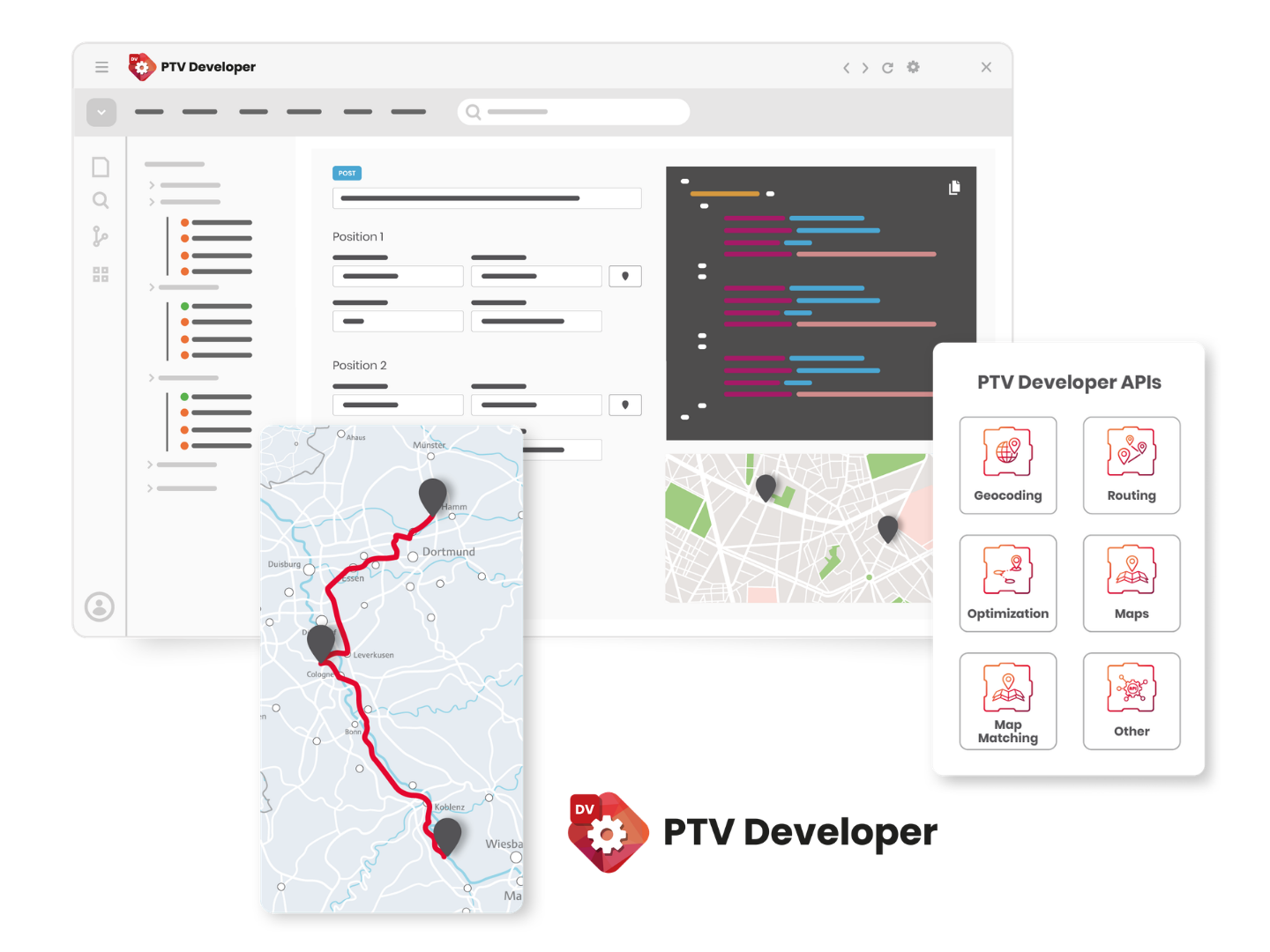
PTV Logistics takes an integration-first approach to making this connection possible. PTV Developer, for example, provides 17 individual APIs – covering routing, geocoding, and map data – that teams can mix and match depending on what they’re building, from a single routing call to a full planning integration that scales from 10 to more than 10,000 daily routes. That flexibility means an optimization platform can plug directly into your existing TMS, WMS, or custom tooling, rather than forcing you to replace it.
Road-Centric Visibility Closes the Loop
True optimization doesn’t stop once the driver leaves the depot. To stay competitive in courier express parcel routing, you need to close the loop between the plan and the reality. By integrating optimization with visibility tools such as PTV Axylog, real-time transport visibility software that is modular, flexible, and customizable — providers gain road-centric visibility. This allows you to monitor how your execution compares to your plan in real-time. You can also capture accurate data automatically on drive times, service times, and distances. And you can utilize this information to improve your future planning, refining your strategic network design and making your future route optimization for CEP even more accurate.
Business Impact – From Challenges to Profitable, Scalable CEP Operations
In the high-volume world of CEP optimization, where margins are often tight, any efficiency hurdle created by standard tools quickly becomes a massive financial strain. By following the metrics below closely, you’ll see exactly what kind of impact optimization-first planning can have.
| KPI | Impact of Route Optimization |
|---|---|
| Cost per Stop / Cost per Parcel | By maximizing sequence efficiency, you reduce the primary variable cost of every delivery. |
| Route Mileage (km/miles driven) | Optimized courier express parcel routing reduces total kilometers driven, directly lowering fuel consumption and vehicle wear and tear. |
| Drop Density (stops per hour/route) | Increasing the number of stops per hour or per route allows you to handle more volume without increasing your fleet size. |
| On-Time Delivery Performance | Precise constraint modeling ensures delivery windows are met consistently, SLAs are fulfilled, and the likelihood of costly redeliveries is reduced. |
| Fleet Utilization | Optimization ensures vehicles are filled to their true capacity and that drivers’ working hours are utilized effectively, eliminating dead miles and idle time. |
| Planner Productivity | Instead of spending hours manually fixing a plan, your team can manage more routes in less time, with less time spent per plan. |
| CO₂ Emissions | Lowering your mileage and rate of failed delivery attempts generates a measurable reduction in your carbon footprint. |
The ROI of your chosen route optimization tool for the CEP sector is independent and measurable. When you look at the hidden costs of staying with a basic TMS module, switching to a dedicated optimization engine simply makes sense.
Crisp, the app-only supermarket specialist, provides the perfect example of the importance of upgrading. By moving beyond basic planning to PTV OptiFlow, they transformed their high-velocity delivery model for ultra-fresh goods. The shift from manual, theory-based routing to an automated, optimization-first approach allowed them to master tight one-hour windows while managing an electric fleet. The results were a significant 23% reduction in total kilometers driven and an 11% decrease in driving time, which translated into a 13% saving in total logistics costs. This proves that for a modern CEP optimization strategy, specialized software is the key to maintaining a 95%+ on-time delivery rate during rapid scaling.
In the modern CEP landscape, routing that’s good enough leads to stagnation. Your TMS is a vital foundation for your business, but to thrive in a high-volume, low-margin environment, you need an optimization engine that understands the road as well as you do.